
Symptoms happening now? Stop reading and call an ambulance.
Pakistan 1122 or 115 · India 112 · USA/Canada 911 · UK 999 · EU 112 · UAE 998 · Saudi Arabia 997 · Australia 000. Do not drive yourself to hospital.
Real heart attacks are often far quieter than the ones on television. Many begin with a vague pressure in the chest that fades and returns, getting out of breath on the stairs, a sudden clammy sweat, or a jaw ache that feels like a bad tooth. Spotting these heart attack warning signs early, and calling for help within minutes, gives the heart muscle its best chance.
This guide walks through the 10 warning signs in plain language: what each one feels like, why it happens and what to do. It also includes a free 60-second symptom checker, a heart risk factor checker and a printable emergency card. It is written for adults, especially people over 40 and anyone looking after an older parent.
Quick answer: what are the warning signs of a heart attack?
The most common heart attack warning sign is pressure, squeezing, tightness or pain in the centre of the chest that lasts more than a few minutes, or goes away and comes back. Other signs are pain spreading to one or both arms, the neck, jaw, back or upper stomach; shortness of breath; a cold sweat; nausea or vomiting; light-headedness; and unusual tiredness. Women, older adults and people with diabetes can have these signs with little or no chest pain. If you notice them, call your local emergency number straight away.
Key takeaways
- Chest discomfort is the most common sign in both men and women, but it is often pressure or heaviness rather than sharp pain.
- About 1 in 5 heart attacks are “silent”, so mild signs such as breathlessness or fatigue still count.
- Call an ambulance; don’t drive. Paramedics can start treatment and alert the hospital on the way.
- Aspirin is a second step, never a replacement for calling, and it is not for everyone.
- Most heart attacks are linked to risks you can change: blood pressure, cholesterol, blood sugar, tobacco, weight and activity.
What happens during a heart attack?
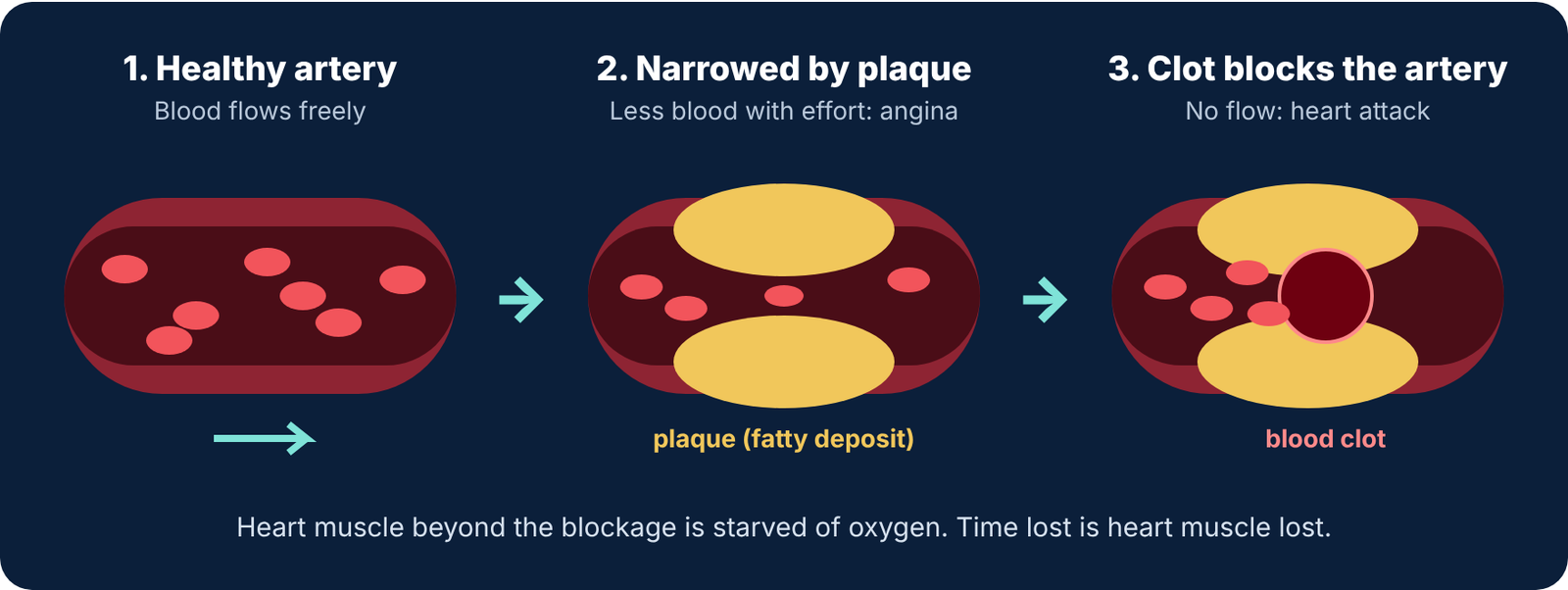
A heart attack, called a myocardial infarction by doctors, happens when the blood supply through one of the coronary arteries suddenly stops. These small arteries wrap around the heart and feed its muscle. In most cases a fatty build-up called plaque splits open, a blood clot forms over the crack, and the artery is blocked. The muscle downstream runs out of oxygen and starts to die.
The damage grows minute by minute, which is why doctors say time is muscle. Reopening the artery quickly, with a stent or clot-busting medicine, saves more of the heart.
Heart attack vs cardiac arrest: they are not the same. During a heart attack the person is usually awake, talking and breathing, and the heart keeps beating. In cardiac arrest the heart suddenly stops pumping effectively; the person collapses, stops responding and is not breathing normally. A heart attack can trigger a cardiac arrest, which is one more reason to call early.
The 10 warning signs of a heart attack at a glance
Use this table as a quick reference. The badge shows how fast to act. If you are unsure, treat it as an emergency.
| # | Warning sign | What it can feel like | Action |
|---|---|---|---|
| 1 | Unusual fatigue | New, heavy tiredness that rest or sleep doesn’t fix | See a doctor soon Emergency with other signs |
| 2 | Chest discomfort that comes and goes | Pressure or tightness with effort or stress that eases with rest | Urgent check Emergency if it lasts minutes or comes at rest |
| 3 | Shortness of breath | Breathless with light activity or at rest, with or without chest pain | Emergency if sudden |
| 4 | Cold sweat | Clammy, heavy sweating for no clear reason | Emergency with other signs |
| 5 | Sudden weakness | Heavy arms or legs; simple jobs feel too hard | Emergency One-sided weakness may be a stroke |
| 6 | Nausea, vomiting or “indigestion” | Feeling sick, burning or fullness in the upper stomach or chest | Emergency with other signs |
| 7 | Dizziness or light-headedness | Faint, woozy, or actually passing out; racing or irregular heartbeat | Emergency with other signs |
| 8 | Crushing chest pressure | Squeezing or a heavy weight in the chest for more than a few minutes | Emergency: call now |
| 9 | Pain that spreads | Ache in one or both arms, shoulder, neck, jaw, back or upper stomach | Emergency: call now |
| 10 | Severe breathing difficulty | Gasping, can’t finish sentences, pale, blue or grey lips or skin | Emergency: call now |
What does each heart attack warning sign feel like?
Signs can arrive suddenly and strongly, or build slowly with mild discomfort that comes and goes. You might have one sign or several at once. Here is what to watch for.
Unusual fatigue that rest doesn’t fix
This is different from feeling tired after a long day. People describe a heavy, out-of-character exhaustion that makes ordinary jobs, like carrying shopping or climbing a flight of stairs, feel like hard work, and it is still there after a full night’s sleep. The American Heart Association counts unusual tiredness among the warning signs, and the CDC notes it is reported more often by women, sometimes days or weeks beforehand.
Why it happens: a heart that is short of blood pumps less strongly, so the rest of the body receives less oxygen.
Act: new, unexplained tiredness lasting more than a few days needs a doctor’s appointment. If it comes with chest discomfort, breathlessness or a cold sweat, call emergency services.
Chest discomfort that comes and goes
Plenty of heart attacks start with mild discomfort rather than severe pain: a pressure, tightness, fullness or dull ache in the middle of the chest. It may show up when you walk quickly, climb stairs or feel stressed, and settle when you stop. This pattern is called angina, and it usually means a coronary artery has narrowed so the heart can’t get enough blood when it works harder.
Why it matters: angina can be an early warning that a heart attack is coming. Angina that is new, getting more frequent, or happening at rest is called unstable angina and is treated as an emergency.
Act: chest discomfort lasting more than a few minutes, or settling and returning, is an emergency. If you already have angina and your GTN spray doesn’t ease the pain as your doctor said it should, call an ambulance.
Shortness of breath, with or without chest pain
Getting suddenly out of breath after a short walk, while folding clothes or even while sitting still can be a heart warning. The CDC points out it can start before any chest discomfort, or happen without it, so people often blame being unfit or a chest infection.
Why it happens: a struggling heart can’t move blood through the lungs efficiently, and if the pump is badly weakened (heart failure), fluid can collect in the lungs.
Act: sudden or unusual breathlessness is an emergency, especially with chest discomfort, sweating or nausea.
A cold sweat for no obvious reason
Breaking into a cold, clammy sweat when you are not hot, exercising or nervous is a classic sign that is easy to overlook. People often say they were suddenly soaked, or that someone told them they looked grey.
Why it happens: a heart under strain switches on the body’s alarm system (the fight-or-flight response), which triggers sweating.
Act: a cold sweat together with chest discomfort, breathlessness or nausea is an emergency. Call immediately.
Sudden weakness
Suddenly feeling weak, with arms that feel heavy or legs that won’t hold you, can go along with a heart attack, especially in older adults. It often comes with tiredness, light-headedness or breathlessness.
Act: sudden, unexplained weakness is never “just tiredness”. Call for help.
Nausea, vomiting or “indigestion”
Feeling sick, vomiting, or a burning, full or bloated feeling in the upper stomach or chest can all be heart attack symptoms. The NHS lists indigestion-like feelings as a symptom, and this is one of the biggest reasons people delay: they blame something they ate.
Why it happens: the heart and upper digestive organs share nerve pathways, so trouble in the heart can be felt as stomach symptoms.
Act: “indigestion” that is new for you, doesn’t settle with antacids, or comes with sweating, breathlessness or chest tightness should be treated as a possible heart attack. See our guide to heart attack or heartburn warning signs.
Dizziness, light-headedness or a racing heartbeat
Feeling faint, woozy or unsteady, or actually passing out, can mean the heart is not pumping enough blood to the brain. A heart attack can also upset the heart’s rhythm, and the AHA lists a rapid or irregular heartbeat among the other possible signs.
Act: light-headedness with chest discomfort or breathlessness is an emergency. If someone collapses and isn’t breathing normally, call emergency services and start CPR.
Crushing chest pressure
This is the sign most people know: a heavy, squeezing or crushing feeling in the centre of the chest, often described as a weight sitting on the chest or a tight band around it. The WHO describes it as pressure or tightness rather than a sharp pain. It can build gradually or come on suddenly, and it doesn’t go away with rest.
Why it happens: usually a clot has formed on a ruptured plaque and is blocking a coronary artery.
Act: call emergency services at once. Don’t wait to see if it passes, and don’t drive yourself.
Pain that spreads to the arm, neck, jaw, back or stomach
Heart attack pain often travels. It can spread to one or both arms (often the left), the shoulders, neck, jaw, upper back or upper stomach. Sometimes it is felt only in these places, as a dull ache, heaviness, or something like toothache.
Why it happens: nerves from the heart enter the spinal cord at the same levels as nerves from the arm, neck and jaw, so the brain can misread where the pain is coming from. This is called referred pain.
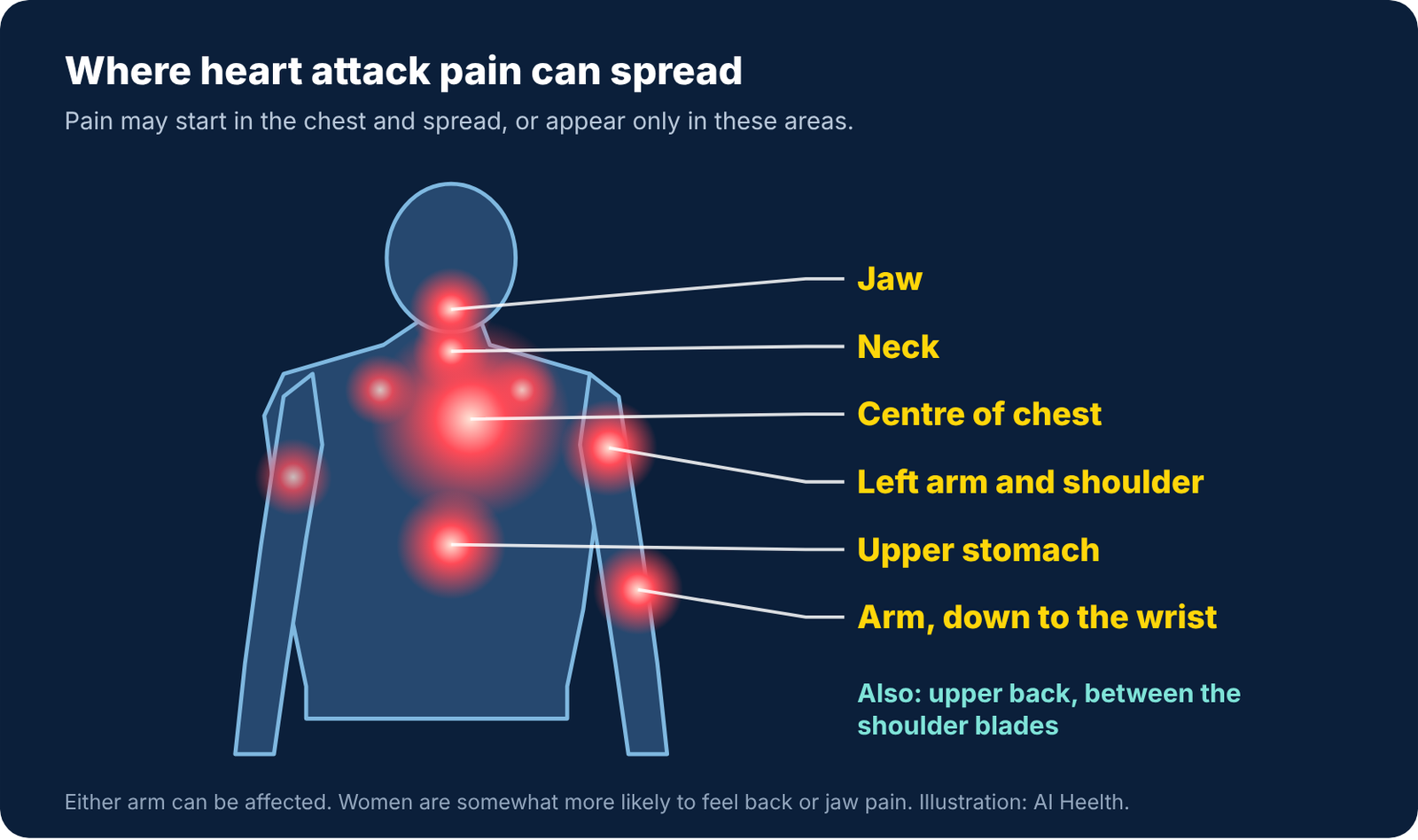
Act: chest discomfort that spreads, or new unexplained pain in these areas together with other signs, is an emergency.
Severe breathing difficulty
Struggling hard to breathe, gasping, feeling as if you are suffocating, or being unable to finish a sentence is a red-flag emergency. The NHS also lists pale, blue or grey skin or lips; on black or brown skin this can be easier to see on the palms of the hands.
Why it happens: a badly weakened heart can let fluid back up into the lungs (acute heart failure), or the heart rhythm may be dangerously disturbed.
Act: call emergency services immediately and keep the person sitting upright while you wait.
Are heart attack symptoms different in women, older adults and people with diabetes?
Yes. Chest pain or discomfort is still the most common symptom for everyone. But the WHO notes that women, older people and people with diabetes more often have atypical symptoms, such as breathlessness, fatigue, indigestion-like discomfort, or back and jaw pain, frequently without much chest pain. These quieter symptoms are a major reason people reach hospital late.
| Group | What may be different | Why it gets missed |
|---|---|---|
| Women | More likely to have shortness of breath, nausea or vomiting, unusual tiredness, anxiety, and back, shoulder, neck or jaw pain, with or without chest pain | Put down to stress, flu, menopause or indigestion |
| Adults over 65 | Chest pain may be mild or missing; breathlessness, sudden weakness, confusion or fainting may be the main sign | Blamed on “old age” or other illnesses |
| People with diabetes | Nerve damage can dull pain, so chest pain may be faint or absent; breathlessness and fatigue are more common | No “classic” pain to raise the alarm |
| Silent heart attack | Very mild or no symptoms; damage found later on an ECG or scan | The person never realises it happened |
Read more in our guides to heart attack symptoms in women and silent heart attack warning signs.
Is it a heart attack or something else?
Several conditions can feel similar. The table shows typical differences, but you can’t reliably tell them apart at home; doctors need an ECG and blood tests (troponin). If you are unsure, treat it as a heart attack.
| Condition | Typical feeling | Pattern | What to do |
|---|---|---|---|
| Heart attack | Pressure, squeezing, heaviness; may spread to arm, jaw or back; sweating, nausea, breathlessness | Lasts more than a few minutes or comes and goes; doesn’t settle with rest | Call emergency now |
| Stable angina | Similar tightness or pressure | Triggered by effort or stress; eases within a few minutes of rest or GTN | See a doctor Emergency if new, worse or at rest |
| Heartburn (acid reflux) | Burning behind the breastbone, sour taste | After meals or lying down; often eased by antacids | Manage / see GP Emergency if any doubt |
| Panic attack | Racing heart, fear, tingling, fast breathing | Usually peaks within about 10 minutes and passes | Get checked A first episode needs a medical check |
| Stroke | Face drooping, weakness on one side, slurred speech | Sudden onset | Call emergency now |
| Cardiac arrest | Sudden collapse, unresponsive, not breathing normally | Immediate | Call + start CPR |
Related reading: signs and symptoms of anxiety and low vitamin B1 and heartburn.
Should I call an ambulance? Free 60-second symptom checker
Tick anything happening right now, to you or the person you are with. This checker does not diagnose anything; it simply tells you when not to wait.
Is any of this happening now?
Your answers stay on your device and are not sent anywhere.
What should you do if you think you’re having a heart attack?
Every minute matters. Current ACC/AHA guidance aims to reopen a fully blocked artery within 90 minutes of first medical contact, and people treated hours after symptoms start are more likely to have lasting heart damage. The longest delay is usually time spent waiting at home. The AHA notes that calling an ambulance is almost always the fastest route to treatment.
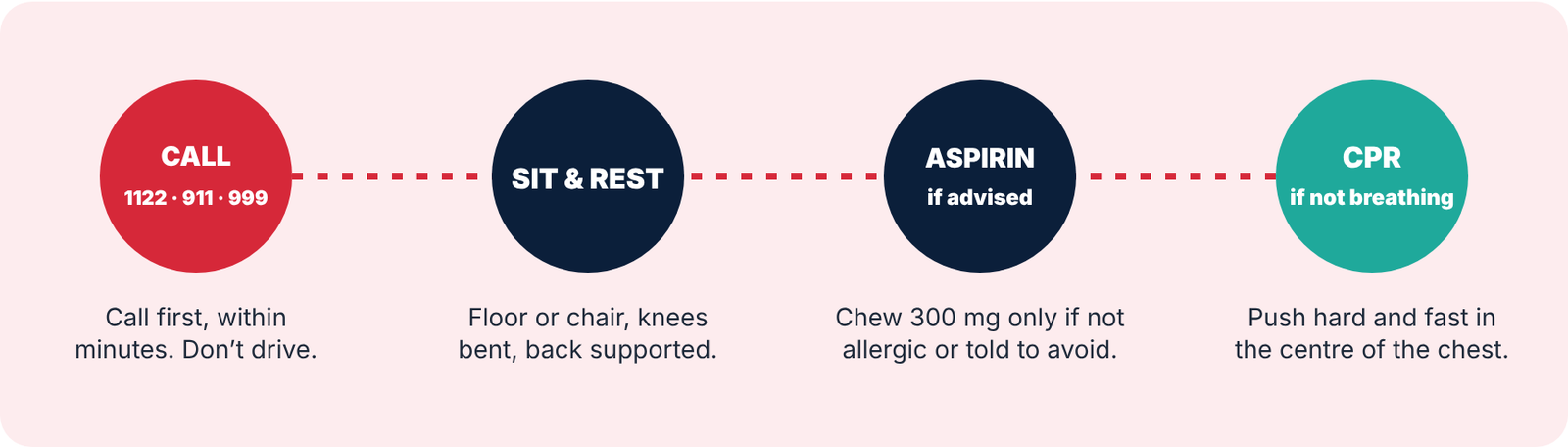
- Call your emergency number now. Say “I think this is a heart attack” and give your exact location. Ambulance crews can record an ECG, start treatment and alert the hospital on the way.
- Stop, sit down and rest. The NHS suggests sitting on the floor with your knees bent and your back supported, or on a chair. If you are alone, unlock the door.
- Aspirin, only if it is safe for you. NHS advice is to take one 300 mg aspirin if you have one and are not allergic; chewing it works fastest. Skip it if you are allergic, a doctor has told you not to take it, or the signs point to a stroke, and follow the call-taker’s advice. Tell the paramedics if you took it. If you have angina, use your GTN spray as prescribed.
- Stay with the person and watch their breathing. If they stop responding and are not breathing normally, start CPR: push hard and fast in the centre of the chest, 100 to 120 times a minute, at least 5 cm (2 inches) deep, and send someone for a defibrillator (AED). If you are not trained, the call-taker will guide you through hands-only CPR.
Don’t
- Wait to “see if it passes” or try to sleep it off
- Drive yourself, or be driven, instead of calling an ambulance
- Walk around or exert yourself
- Take someone else’s heart medicines or extra doses
- Worry about a false alarm; paramedics would much rather check you
Emergency numbers
| Pakistan | 1122 (Rescue) · 115 (Edhi) |
| India | 112 · 108 (ambulance) |
| Bangladesh | 999 |
| USA & Canada | 911 |
| UK | 999 or 112 |
| European Union | 112 |
| UAE | 998 (ambulance) |
| Saudi Arabia | 997 (ambulance) |
| Australia | 000 |
Your heart attack emergency card
Signs: chest pressure for minutes or coming and going · pain in the arm, neck, jaw, back or stomach · breathlessness · cold sweat · nausea · light-headedness.
Do: call emergency services → sit and rest → aspirin 300 mg only if safe for you → CPR if not breathing.
Fill in the boxes, then print the card or take a screenshot. Nothing you type is saved or sent.
Watch: 10 heart attack signs women and over-40s often miss
Prefer to watch? This AI Heelth video walks through every warning sign, explains why women and people over 40 often miss them, and shows exactly what to do.
Related story: The heart attack warning signs he ignored (opens YouTube).
Who is most at risk of a heart attack?
Heart attacks can happen at any age, but risk climbs after about 45 in men and 55 in women. The WHO groups the main risk factors below. Most heart attacks are linked to factors that can be changed.
Risks you can change
- High blood pressure (why it’s called the silent killer)
- High cholesterol and blood fats
- Diabetes and high blood sugar
- Smoking and all other tobacco use
- Overweight and obesity (check your BMI)
- Inactivity, a diet high in salt, sugar and unhealthy fats, and harmful alcohol use
- Long-term stress and air pollution
Risks you can’t change
- Older age
- Being male (women’s risk rises after menopause)
- A family history of early heart disease
- A previous heart attack, angina or stroke
If these apply to you, regular check-ups and knowing the warning signs matter even more.
Free heart risk factor checker
Answer a few questions to see which risk factors apply to you and get a personal action list. Takes about one minute. Nothing is stored or sent.
Tick everything that applies:
How can you lower your risk of a heart attack?
Small habits, kept up, make a real difference. Stop all tobacco. Aim for at least 150 minutes of moderate activity a week. Fill your plate with vegetables, fruit, whole grains, pulses and nuts, and cut back on salt, sugar and processed food. Keep blood pressure, cholesterol and blood sugar within the targets your doctor sets, and take prescribed medicines as directed. Explore our guides to the best nuts for heart health, good vs bad fats, blood pressure myths vs facts and how to lower HbA1c.
Frequently asked questions
What is usually the first sign of a heart attack?
For most people it is discomfort in the centre of the chest: pressure, squeezing, fullness or pain that lasts more than a few minutes or goes away and comes back. Some people, especially women, older adults and people with diabetes, notice breathlessness, unusual tiredness, nausea, or jaw or back pain first.
Can heart attack symptoms start days or weeks before?
Yes, in some people. Unusual fatigue, breathlessness or chest discomfort on effort can appear days or weeks beforehand, particularly in women. But a heart attack can also strike without any earlier warning, so never wait for a pattern before calling for help.
How long does heart attack chest pain last?
Heart attack discomfort usually lasts more than a few minutes, or fades and returns. Very brief, sharp pains lasting a few seconds are less likely to come from the heart, but any chest pain that worries you should be checked.
Can you have a heart attack without chest pain?
Yes. Some heart attacks cause mainly breathlessness, nausea, sweating, tiredness, or pain in the arm, jaw or back. The CDC estimates that about 1 in 5 heart attacks are silent, meaning the damage happens without the person realising.
Which arm hurts during a heart attack?
Pain often spreads to the left arm, but it can affect the right arm or both arms, as well as the shoulders, neck, jaw or back. Don’t rule out a heart attack because the pain is on the “wrong” side.
How do I tell a heart attack from heartburn or a panic attack?
You can’t reliably tell at home. Heartburn usually burns after meals and eases with antacids, and panic attacks often peak within about 10 minutes. Heart attacks can mimic both, so if you are unsure, especially with sweating, breathlessness or spreading pain, call emergency services.
Should I take aspirin during a heart attack?
Call for help first. NHS advice is to take one 300 mg aspirin while waiting for the ambulance if you have one and are not allergic. Don’t take it if a doctor has told you to avoid aspirin or if the signs point to a stroke, and follow the call-taker’s advice.
Is it safe to drive myself to hospital?
No. Call an ambulance. You could collapse at the wheel, and paramedics can start treatment, record an ECG and alert the hospital before you arrive, which often means faster treatment.
What is the difference between a heart attack and cardiac arrest?
A heart attack is a blood-flow problem: an artery is blocked, but the person is usually awake and breathing. Cardiac arrest is an electrical problem: the heart suddenly stops pumping, and the person collapses and stops breathing normally. A heart attack can lead to cardiac arrest, which needs CPR and a defibrillator straight away.
Can young people have a heart attack?
Yes, although it is less common. Smoking, diabetes, high cholesterol (including inherited familial hypercholesterolaemia), a strong family history and drug use such as cocaine raise the risk in younger adults. The warning signs and what to do are the same at any age.
Medical disclaimer: This article is for general education only. It is not medical advice and cannot diagnose you. The checkers on this page do not replace a medical assessment. Always speak to a qualified healthcare professional about your health. If you think you or someone else is having a heart attack, call your local emergency number immediately.
How we create and review content: AI Heelth articles are written in plain language from current guidance by the World Health Organization, the American Heart Association and American College of Cardiology, the NHS and the CDC, checked line by line against those sources, and updated when guidance changes.
Sources
- World Health Organization. Heart attack: fact sheet. 10 September 2026.
- American Heart Association. Warning Signs of a Heart Attack.
- NHS. Heart attack. Page last reviewed 31 March 2026.
- Centers for Disease Control and Prevention. Heart Disease Facts and About Heart Attack Symptoms, Risk, and Recovery.
- Rao SV, et al. 2025 ACC/AHA/ACEP/NAEMSP/SCAI Guideline for the Management of Patients With Acute Coronary Syndromes. Circulation. 2025;151(13):e771–e862.
- Resuscitation Council UK. 2025 Adult Basic Life Support Guidelines.
- DeVon HA, Penckofer S, Larimer K. The association of diabetes and older age with the absence of chest pain during acute coronary syndromes. Western Journal of Nursing Research. 2008.
Last reviewed: 15 November 2026 · Next review: May 2027 · AI Heelth Editorial Team