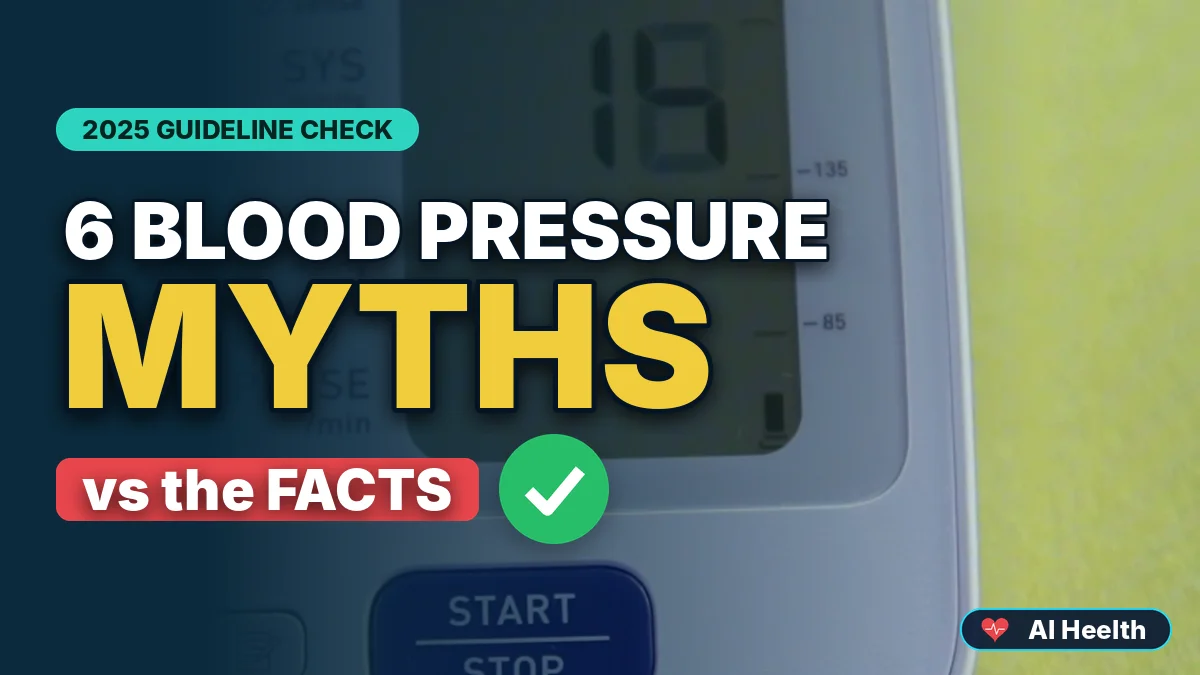
The most harmful blood pressure myths are the ones that make people ignore their numbers or quit treatment: “it’s in my genes”, “it’s not that high”, “pills only hide the problem”, “salt doesn’t matter”, “my weight isn’t the issue” and “one reading tells you everything”. Under the 2025 AHA/ACC guideline, normal is below 120/80 mm Hg and hypertension begins at 130/80. Each 10 mm Hg fall in systolic pressure is linked to roughly 20% fewer heart attacks, strokes and other major cardiovascular events. Cutting sodium, losing excess weight, moving more, limiting alcohol and, when needed, taking medication all bring blood pressure down.
In this guide
- What the two numbers mean
- Blood pressure chart (2025)
- Free blood pressure checker
- What changed in 2025
- Myth 1: It’s all in your genes
- Myth 2: It’s not that high
- Myth 3: Pills only hide the problem
- Myth 4: Salt doesn’t matter
- Myth 5: Weight isn’t the issue
- Myth 6: One reading tells you everything
- What to do above 180/120
- How to measure at home
- What actually lowers blood pressure
- FAQs
- References
If you have high blood pressure, you have almost certainly been given advice about it, by relatives, friends, social media or a confident stranger. Some of it helps. Some of it is years out of date. And some blood pressure myths are genuinely dangerous, because hypertension rarely causes symptoms, so bad advice can quietly raise your risk of stroke, heart attack and kidney disease for years before anything feels wrong.
Below, AI Heelth puts six of the most widespread blood pressure myths to the test using the 2025 AHA/ACC high blood pressure guideline, the World Health Organization (WHO) and large clinical trials. For each myth you get a verdict, the evidence and one practical step you can take today. You can also check your own readings with our free checker, which averages several readings the way clinicians do.
What do the two numbers in a blood pressure reading mean?
The top number, systolic pressure, is the force in your arteries while your heart squeezes. The bottom number, diastolic pressure, is the force that remains while your heart relaxes and refills between beats. Both are measured in millimetres of mercury (mm Hg), so a reading of 128/78 is said “128 over 78”.
A common mix-up: the bottom number is not “the resistance of your blood vessels”. It is simply the pressure left in the arteries while the heart rests. A high value in either number is enough to move you into a higher category.
What are the blood pressure categories in 2025? (Blood pressure chart)
For adults, normal blood pressure is below 120/80 mm Hg. Elevated means 120–129 systolic with diastolic under 80. Stage 1 hypertension is 130–139 systolic or 80–89 diastolic, and stage 2 is 140/90 or higher. The 2025 AHA/ACC guideline kept the 2017 categories and set a treatment target below 130/80 for most adults, with an encouragement to aim for under 120 systolic where it is safe.1
| Category | Systolic (top) | Diastolic (bottom) | What it usually means | |
|---|---|---|---|---|
| Normal | Below 120 | and | Below 80 | Keep up healthy habits; check at least once a year |
| Elevated | 120–129 | and | Below 80 | An early warning: start lifestyle changes now |
| Stage 1 | 130–139 | or | 80–89 | Lifestyle changes. Medication now if you have heart disease, diabetes, kidney disease or a 10-year risk of 7.5% or more; otherwise if readings stay at or above 130/80 after 3–6 months |
| Stage 2 | 140 or higher | or | 90 or higher | Lifestyle changes plus medication, often two medicines in one pill |
| Severe | Higher than 180 | and/or | Higher than 120 | Recheck after at least 1 minute; get care urgently (see below) |
Sources: 2025 AHA/ACC guideline1; American Heart Association.2 “Pre-hypertension” is an outdated label; 120–129 over less than 80 is now called “elevated”. Categories apply to non-pregnant adults and are based on the average of two or more readings taken on two or more occasions.
Free blood pressure checker: what category am I in?
Enter one to three readings taken at rest, 1 minute apart. Doctors use the average of several readings, so the checker does too. It uses the 2025 AHA/ACC adult categories, shows which number drives your result and tells you what to do next. Everything runs in your browser; nothing is stored or sent.
For adults aged 18+. One reading, or one day of readings, is not a diagnosis: hypertension is confirmed from averages taken on different days. This checker gives general information only and does not replace your doctor.
What changed in the 2025 blood pressure guideline?
The American Heart Association and American College of Cardiology published their first full update since 2017 in August 2025.1 The categories did not change, but several recommendations did:
- Earlier medication for higher-risk people. At stage 1 (130–139/80–89), medication is advised straight away for people with cardiovascular disease, diabetes or chronic kidney disease, or a 10-year risk of 7.5% or more on the new PREVENT risk calculator.1,10
- Two medicines in one pill is favoured to start treatment at stage 2, because it reaches target faster.
- Potassium-based salt substitutes are now recommended for many people, but not if you have kidney disease or take medicines that raise potassium.1
- Stress reduction (meditation, breathing, yoga) is recognised as a helpful add-on, and limiting or avoiding alcohol is advised.
- “Severe hypertension” replaces the older term “hypertensive urgency” for readings above 180/120 without signs of organ damage.
The 6 worst blood pressure myths, checked against the facts
Each blood pressure myth below gets a verdict, the evidence behind it and a step you can take today.
1Myth: “High blood pressure runs in my family, so nothing I do will help.”
Verdict: MythFact: your genes load the dice, but they do not throw them. A parent or sibling with high blood pressure roughly doubles your own chance of developing it.6 Yet blood pressure is influenced by hundreds of genes, each with a small effect, interacting with what you eat, how much you move, how you sleep and how much alcohol you drink. There is no single “hypertension gene” that settles your fate.
Relatives also tend to share recipes, mealtimes, activity levels and stress. Part of what “runs in the family” is really a shared lifestyle, and that part is changeable. Lifestyle and environment can even influence how genes are switched on and off, a field known as epigenetics.
What to do: treat family history as an early warning, not a verdict. Check your blood pressure at least once a year (more often if it is elevated) and start the habits in the what works table before your numbers rise.
2Myth: “Relax, it’s not that high.”
Verdict: MythFact: cardiovascular risk rises step by step once blood pressure passes 120/80, long before you feel anything. That is the whole reason the guideline uses categories: each step up carries more risk of heart attack and stroke.1 Because most people with hypertension feel perfectly well, WHO estimates that around 600 million adults, 44% of everyone with the condition, do not know they have it.3
Year after year, uncontrolled pressure stiffens and damages artery walls and the organs that depend on them.
What to do: find out which category you are in using the checker above. “Elevated” (120–129 over under 80) is the best moment to act, because lifestyle changes alone often bring it back to normal. If your average is 130/80 or higher, book an appointment to agree a plan.
3Myth: “Blood pressure pills only hide the problem.”
Verdict: Myth, and a dangerous oneFact: bringing blood pressure down with medicine prevents strokes, heart attacks and early deaths. A meta-analysis of 123 trials involving more than 600,000 people found that every 10 mm Hg reduction in systolic pressure cut major cardiovascular events by about 20%, stroke by about 27%, heart failure by about 28% and death from any cause by about 13%.4
Medicine does not replace healthy habits, and healthy habits are not always enough on their own. The 2025 guideline advises lifestyle changes for everyone with raised blood pressure, and adds medication for all stage 2 hypertension and for stage 1 when cardiovascular risk is high or readings stay at 130/80 or above after 3–6 months of lifestyle changes.1 Many people do best with both.
Never stop or change your blood pressure medicine on your own. Stopping suddenly can make pressure climb again, and with some medicines it can rebound sharply. If you have side effects, or your lifestyle has improved and you would like to cut down, speak to your doctor; doses can sometimes be reduced safely with monitoring.
4Myth: “Salt doesn’t matter, your body balances it out.”
Verdict: MythFact: eating less sodium lowers blood pressure in people with and without hypertension. Your kidneys do adjust how much sodium and water they excrete (a process called pressure natriuresis). But in many people, and increasingly with age, that adjustment does not fully offset a salty diet. Extra sodium holds extra fluid in the circulation, and that raises the pressure inside the arteries.
In the landmark DASH-Sodium trial, lowering sodium reduced blood pressure in every group studied. Pairing a lower-sodium diet with the DASH eating plan cut systolic pressure by about 11.5 mm Hg in people with hypertension and about 7.1 mm Hg in people without it, compared with a typical high-sodium diet.5 WHO advises under 2 g of sodium a day (5 g of salt, a little less than a teaspoon).7 The 2025 AHA/ACC guideline sets an upper limit of 2,300 mg a day with an ideal of about 1,500 mg.1
| Source | Sodium per day | Roughly equal to |
|---|---|---|
| WHO | Less than 2,000 mg | 5 g of salt (just under 1 teaspoon) |
| AHA/ACC 2025 (upper limit) | Less than 2,300 mg | About 1 teaspoon of salt |
| AHA/ACC 2025 (ideal) | About 1,500 mg | About 2/3 teaspoon of salt |
What to do: most sodium comes from bread, sauces, pickles, snacks, restaurant meals and street food, not the salt shaker. Read labels, pick lower-sodium versions and flavour food with herbs, lemon, garlic and spices. Eat more potassium-rich foods such as vegetables, fruit, beans and lentils. A potassium-based salt substitute can help too, but check with your doctor first if you have kidney disease or take medicines that raise potassium (for example ACE inhibitors, ARBs or spironolactone).
5Myth: “My weight isn’t the issue, so losing some won’t help.”
Verdict: MythFact: shedding excess weight is one of the most dependable ways to lower blood pressure. A meta-analysis of 25 randomised trials found blood pressure fell by roughly 1 mm Hg for each kilogram lost.8 The 2025 guideline gives a realistic first goal: if you live with overweight or obesity, aim to lose at least 5% of your body weight, which is 4 kg for someone weighing 80 kg.1
There is a grain of truth in the myth: weight is not the only driver, and you do not have to reach an “ideal” weight to benefit. Excess weight often travels with insulin resistance, poor sleep (including sleep apnoea) and inactivity, all of which affect blood pressure. Improving food, movement and sleep together gives the biggest gains.
What to do: start with a 5% target, track your waist size as well as the scale, and combine smaller portions with more daily movement. If weight loss is hard, ask your doctor about structured programmes; the 2025 guideline also notes newer weight-loss medicines may suit some people with obesity and hypertension.
6Myth: “One high reading means I have high blood pressure.”
Verdict: Partly true, needs confirmingFact: a single high reading is a reason to recheck, not a diagnosis. Blood pressure moves all day with stress, caffeine, activity, a full bladder, talking and even a crowded clinic. Some people read higher in the clinic than at home (the “white-coat” effect); others read normal in the clinic but high at home (“masked” hypertension).
That is why hypertension is diagnosed from the average of several careful readings on different days, and why the AHA recommends home monitoring for people with high blood pressure.9 The opposite mistake is just as risky: brushing off a high reading as “only stress”. Recheck it, and log it.
What should you do if your blood pressure is above 180/120?
A reading above 180/120 is severe hypertension. Do not wait days to see whether it settles. The American Heart Association advises:2
- Sit quietly, wait at least 1 minute and measure again.
- If it is still above 180/120 and you have no symptoms, contact your doctor straight away.
- If you have chest pain, shortness of breath, back pain, numbness, weakness, a change in vision or difficulty speaking, call emergency services now (1122 in Pakistan, 911 in the US, 999 in the UK, or your local number). Do not drive yourself.
These symptoms can signal organ damage in progress, such as a stroke, heart attack or a tear in the aorta (aortic dissection). In pregnancy, lower thresholds apply: 160/110 or higher, or a severe headache, vision changes or upper belly pain, needs same-day emergency care.11
How do you measure blood pressure correctly at home?
Use a validated upper-arm monitor, rest for 5 minutes, sit with your back supported and feet flat, rest your bare arm on a table at heart level, stay silent and take two readings 1 minute apart. Small errors, such as a dangling arm or crossed legs, can add several points to the result.
Before you measure
- For 30 minutes beforehand: no smoking, caffeine, alcohol or exercise.
- Empty your bladder.
- Use an automatic upper-arm monitor that has been clinically validated (you can check a device at ValidateBP.org) with the correct cuff size for your arm. Wrist and finger devices are less reliable.
When to measure
- Measure at the same times each day, for example in the morning (before medicines and breakfast) and in the evening.
- Record every reading with the date and time, or use your monitor’s memory, and take the log to appointments. The checker above can average a sitting’s readings for you.
- Use the same arm each time unless your doctor advises otherwise.
What actually lowers blood pressure?
The changes with the strongest evidence are a DASH-style diet, less sodium, losing excess weight, regular physical activity, little or no alcohol and, when needed, medication. Their effects add up: two or three changes together usually lower blood pressure more than any single one.
| Change | Practical target | Evidence |
|---|---|---|
| DASH-style eating | Vegetables, fruit, whole grains, beans, nuts, low-fat dairy; less red meat, sweets and sugary drinks | Strong With low sodium: about 11.5 mm Hg lower systolic in people with hypertension5 |
| Less sodium, more potassium | Under 2,300 mg sodium a day, ideally about 1,500 mg; potassium-rich foods; potassium salt substitute if safe for you | Strong Lowers BP with or without hypertension1,5 |
| Weight loss | At least 5% of body weight if overweight | Strong About 1 mm Hg lower per kg lost8 |
| Physical activity | About 150 minutes a week of moderate activity such as brisk walking, plus some resistance exercise | Strong Recommended for all adults1 |
| Alcohol | Ideally none; if you drink, no more than 2 drinks a day for men and 1 for women | Strong Guideline advice1 |
| Stress reduction | Slow breathing, meditation or yoga most days; good sleep | Supportive An add-on to the steps above, not a replacement1 |
| Medication | As prescribed, often started together with lifestyle changes | Strong 10 mm Hg lower = about 20% fewer major heart events4 |
What about stress?
Stress pushes blood pressure up for a while through the fight-or-flight response, and long-term stress is tied to poorer sleep, less activity and less healthy eating. The 2025 guideline now supports stress-reduction techniques such as meditation, breathing exercises and yoga alongside other lifestyle changes and medication.1 Free techniques work; you do not need an expensive gadget or subscription.
Advice with weak or no evidence
- Spinal adjustments or chiropractic care are not a recommended treatment for high blood pressure.
- Cutting out all vegetable oils: heart guidelines advise swapping saturated fat (fatty meat, butter, ghee) for liquid oils such as olive or canola. See our guide to good vs bad fats.
- Special blood tests “instead of” treatment: tests such as hs-CRP, insulin or Lp(a) can add information about heart risk, but they never replace measuring and treating blood pressure.
- Herbal “cures” sold to replace medicine: no supplement has been shown to substitute for proven treatment, and some interact with prescribed drugs. Ask your doctor or pharmacist before trying one.
Blood pressure myths vs facts at a glance
| Myth | Fact | Do this instead |
|---|---|---|
| It’s in my genes; nothing helps | Family history about doubles risk, but lifestyle strongly shapes it | Check yearly; start healthy habits early |
| It’s not that high | Risk rises from 120/80 upward, usually without symptoms | Know your category; act at “elevated” |
| Pills only hide the problem | Lowering BP prevents strokes, heart attacks and deaths | Take medicine as prescribed; never stop alone |
| Salt doesn’t matter | Less sodium lowers BP, with or without hypertension | Under 2,300 mg a day, ideally about 1,500 mg |
| Weight isn’t the issue | About 1 mm Hg lower per kg lost | Aim to lose 5% if overweight |
| One high reading = hypertension | Diagnosis uses the average of several readings on different days | Recheck, log and average at home |
Key takeaways
- Normal blood pressure is below 120/80; hypertension starts at 130/80 under the 2025 AHA/ACC guideline.
- High blood pressure rarely causes symptoms. Measuring it is the only way to know.
- Genes raise risk, but sodium, weight, activity, alcohol, sleep and stress all change it.
- Blood pressure medicine prevents strokes and heart attacks. Never stop it without your doctor.
- Above 180/120: recheck after at least 1 minute; with symptoms, call emergency services immediately.
Keep learning: read why high blood pressure is called the silent killer, and learn the warning signs of a silent heart attack.
Frequently asked questions about blood pressure myths
What is a normal blood pressure for adults?
Normal blood pressure for adults is below 120/80 mm Hg. Readings of 120–129 systolic with diastolic below 80 are called elevated. Hypertension starts at 130 systolic or 80 diastolic under the 2025 AHA/ACC guideline.
Is 140/90 high blood pressure?
Yes. An average of 140/90 or higher is stage 2 hypertension under the 2025 AHA/ACC guideline. At this level guidelines recommend lifestyle changes plus medication, so see your doctor.
Is 130/80 high blood pressure?
Yes. An average reading of 130–139 systolic or 80–89 diastolic is stage 1 hypertension. Most people start with lifestyle changes, but medication is advised straight away if you have heart disease, diabetes, kidney disease or a 10-year cardiovascular risk of 7.5% or more.
What blood pressure is an emergency?
A reading higher than 180/120 is severe hypertension. Wait at least 1 minute and recheck. If it is still that high with chest pain, shortness of breath, back pain, numbness, weakness, vision changes or difficulty speaking, call emergency services immediately. Without symptoms, contact your doctor right away.
Can I stop my blood pressure medicine if my readings are normal?
Not on your own. Normal readings often mean the medicine is working, and stopping can make blood pressure rise again. If you have improved your lifestyle and want to reduce your medicine, ask your doctor, who can lower the dose safely and monitor you.
How much salt is safe per day?
WHO recommends less than 2 g of sodium a day, which is 5 g of salt or just under a teaspoon. The 2025 AHA/ACC guideline advises less than 2,300 mg of sodium a day, ideally about 1,500 mg. Most sodium comes from packaged and restaurant food.
Can high blood pressure be reversed without medication?
For some people with elevated blood pressure or low-risk stage 1 hypertension, lifestyle changes alone can bring readings back to normal: less sodium, a DASH-style diet, weight loss, regular activity and little or no alcohol. People with stage 2 hypertension or high cardiovascular risk usually need medication as well.
Is high blood pressure genetic?
Partly. Having a parent or sibling with high blood pressure roughly doubles your risk, but many genes are involved and they interact with diet, weight, activity and stress. Healthy habits lower blood pressure even in people with a strong family history.
When is the best time to check blood pressure at home?
Measure at the same times each day, such as in the morning before medicine and breakfast and in the evening. Rest for 5 minutes first, avoid caffeine, smoking and exercise for 30 minutes, and take two readings 1 minute apart, then use the average.
References
- Jones DW, Ferdinand KC, Taler SJ, et al. 2025 AHA/ACC/AANP/AAPA/ABC/ACCP/ACPM/AGS/AMA/ASPC/NMA/PCNA/SGIM Guideline for the Prevention, Detection, Evaluation and Management of High Blood Pressure in Adults. Hypertension. 2025;82(10):e212-e316. doi:10.1161/HYP.0000000000000249
- American Heart Association. When to Call 911 About High Blood Pressure.
- World Health Organization. Hypertension fact sheet. 25 September 2025.
- Ettehad D, Emdin CA, Kiran A, et al. Blood pressure lowering for prevention of cardiovascular disease and death: a systematic review and meta-analysis. Lancet. 2016;387(10022):957-67. doi:10.1016/S0140-6736(15)01225-8
- Sacks FM, Svetkey LP, Vollmer WM, et al. Effects on blood pressure of reduced dietary sodium and the Dietary Approaches to Stop Hypertension (DASH) diet. N Engl J Med. 2001;344(1):3-10. doi:10.1056/NEJM200101043440101
- Centers for Disease Control and Prevention. Preventing Chronic Disease. Using family history to raise awareness of high blood pressure risk. 2005.
- World Health Organization. Sodium reduction fact sheet.
- Neter JE, Stam BE, Kok FJ, Grobbee DE, Geleijnse JM. Influence of weight reduction on blood pressure: a meta-analysis of randomized controlled trials. Hypertension. 2003;42(5):878-84. doi:10.1161/01.HYP.0000094221.86888.AE
- American Heart Association. Home Blood Pressure Monitoring.
- American Heart Association. Top 10 Things to Know About the New AHA/ACC High Blood Pressure Guideline. 2025.
- American College of Obstetricians and Gynecologists. Gestational Hypertension and Preeclampsia: ACOG Practice Bulletin No. 222. Obstet Gynecol. 2020;135(6):e237-e260. doi:10.1097/AOG.0000000000003891
Medical disclaimer: This article is for general education and is not medical advice, diagnosis or treatment. A single blood pressure reading is not a diagnosis. Always talk to a qualified healthcare professional about your readings and before changing your diet, exercise or any medicine. Never stop or change blood pressure medication without your doctor’s advice. If you have chest pain, shortness of breath, weakness, numbness, or vision or speech changes, call your local emergency number immediately.
© 2026 AI Heelth. Written by the AI Heelth Editorial Team; evidence checked against the sources above. Illustrations created for AI Heelth.