
Health and Fitness After 50: The Complete Evidence-Based Guide
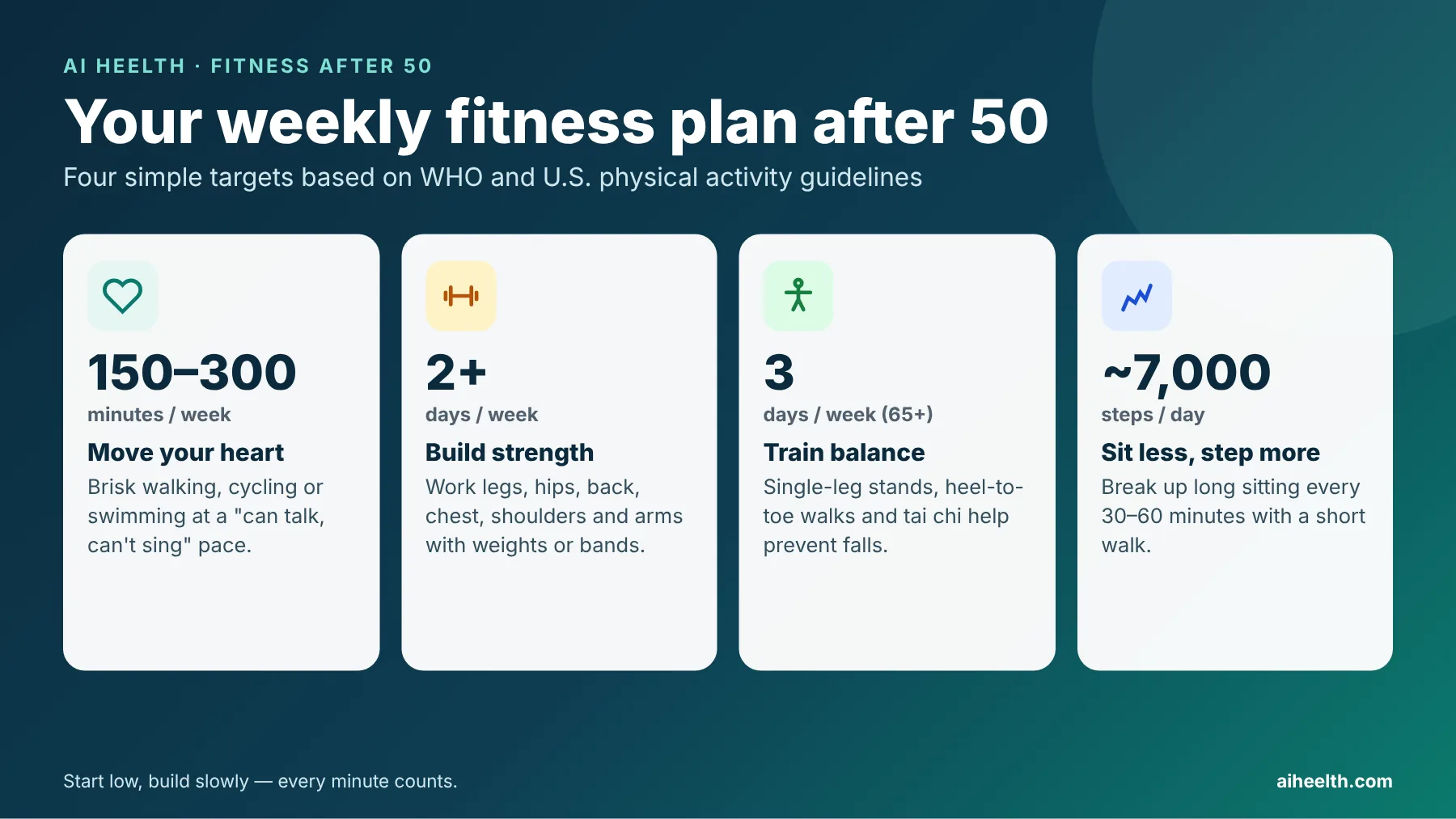
For good health and fitness after 50, aim for 150–300 minutes of moderate activity a week (such as brisk walking), muscle-strengthening exercise on at least 2 days, and balance training on about 3 days a week if you are 65 or older. Sit less, aim for roughly 7,000 steps a day, eat enough protein, and sleep 7 or more hours. If you are new to exercise, start with 10 minutes and build up slowly.
Who this guide is for: adults aged 50 and over, and the families who support them, who want a clear, safe and realistic plan to get fitter. It is general education, not a personal exercise prescription. If you have heart disease, diabetes, uncontrolled blood pressure, recent surgery or a joint problem, check with your doctor first.
*Observational data from a 2025 meta-analysis in The Lancet Public Health; it shows an association, not proof of cause.
In this guide
- Why fitness matters more after 50
- How much exercise you need
- How hard to exercise
- Free fitness planner
- How many steps a day
- The 4 pillars of fitness
- Beginner strength routine
- Sample 7-day plan
- 12-week starter progression
- Test your fitness at home
- Food, protein and hydration
- Sleep, sitting and recovery
- Exercising safely with health conditions
- Myths vs facts
- FAQs
Why do health and fitness matter more after 50?
Your body does not stop responding to exercise as you age. What changes is the cost of doing nothing. From middle age onwards, inactive adults gradually lose muscle mass and strength, a process that speeds up after about 60 and, when severe, is called sarcopenia. Bone density falls, joints stiffen, balance reactions slow, and the heart and blood vessels become less flexible.
The encouraging part is that regular activity slows or partly reverses many of these changes, even when people start in their 60s, 70s or 80s. The World Health Organization (WHO) and the U.S. Department of Health and Human Services (HHS) both report that physically active older adults have lower risks of:
- heart disease, stroke and high blood pressure
- type 2 diabetes and several cancers, including colon and breast cancer
- falls and fall-related injuries such as hip fractures
- depression, anxiety and cognitive decline
- losing the ability to live independently
In short, health and fitness are closely linked at this stage of life: activity also tends to improve sleep, mood, energy and blood sugar control within weeks, long before changes show on the scale.
Why balance gets special attention: according to the U.S. Centers for Disease Control and Prevention (CDC), more than one in four adults aged 65 and over falls each year. Strength and balance training are among the best-studied ways to lower that risk.
How much exercise do you need after 50?
The two major guidelines agree on the core targets. The table below puts them side by side so you can see what applies at 50 and what is added at 65.
| Type of activity | Adults 50–64 | Adults 65+ | Example |
|---|---|---|---|
| Moderate aerobic | 150–300 min/week | 150–300 min/week (or as much as your abilities allow) | Brisk walking, water aerobics, easy cycling |
| Vigorous aerobic (alternative) | 75–150 min/week | 75–150 min/week | Jogging, fast cycling, swimming laps |
| Muscle strengthening | 2+ days/week, all major muscle groups | 2+ days/week, all major muscle groups | Weights, resistance bands, body-weight moves |
| Balance / multicomponent | Recommended, especially if you have had a fall | 3+ days/week (WHO), combined with strength | Tai chi, single-leg stands, dancing |
| Sedentary time | Limit; replace with any activity | Limit; replace with any activity | Stand and walk during TV adverts or calls |
Sources: WHO Guidelines on Physical Activity and Sedentary Behaviour (2020); Physical Activity Guidelines for Americans, 2nd edition (HHS). HHS is preparing a 2027 supplement focused on steps and muscle-strengthening; we will update this page when it is released.
Simple way to hit 150 minutes: 30 minutes of brisk walking on 5 days. If 30 minutes is too much, three 10-minute walks a day count just as well. One minute of vigorous activity counts roughly the same as two minutes of moderate activity.
How hard should you exercise after 50?
“Moderate” and “vigorous” are relative to your own fitness. A brisk walk might be moderate for one person and vigorous for another. Use any of the three checks below; the talk test needs no equipment and works even if you take heart-rate-lowering medicines such as beta-blockers.
| Intensity | Talk test | Effort (0–10 scale) | Approx. % of max heart rate |
|---|---|---|---|
| Light | You can sing | 2–4 | Below 64% |
| Moderate | You can talk in full sentences but not sing | 5–6 | 64–76% |
| Vigorous | You can only say a few words before pausing for breath | 7–8 | 77–95% |
Estimated maximum heart rate uses the Tanaka formula (208 − 0.7 × age), which tends to be more accurate for older adults than the older “220 − age” rule. Treat any heart-rate number as a rough guide, not a target you must reach.
Fitness planner: heart-rate zones and weekly check
Enter your details to see your estimated heart-rate zones and how close your current week is to the guideline targets. Nothing is stored or sent anywhere.
How many steps a day do you need after 50?
You do not need 10,000. A 2025 systematic review and meta-analysis in The Lancet Public Health (Ding and colleagues, 57 studies) compared people walking about 7,000 steps a day with those walking about 2,000. The higher step count was linked to these lower risks:
An earlier analysis of 15 studies (Paluch and colleagues, The Lancet Public Health, 2022) found that for adults aged 60 and over, the benefit for longevity levelled off at around 6,000–8,000 steps a day, compared with 8,000–10,000 for younger adults. If you currently walk 3,000 steps, adding just 1,000 steps a day is a meaningful first goal.
What are the 4 pillars of health and fitness after 50?
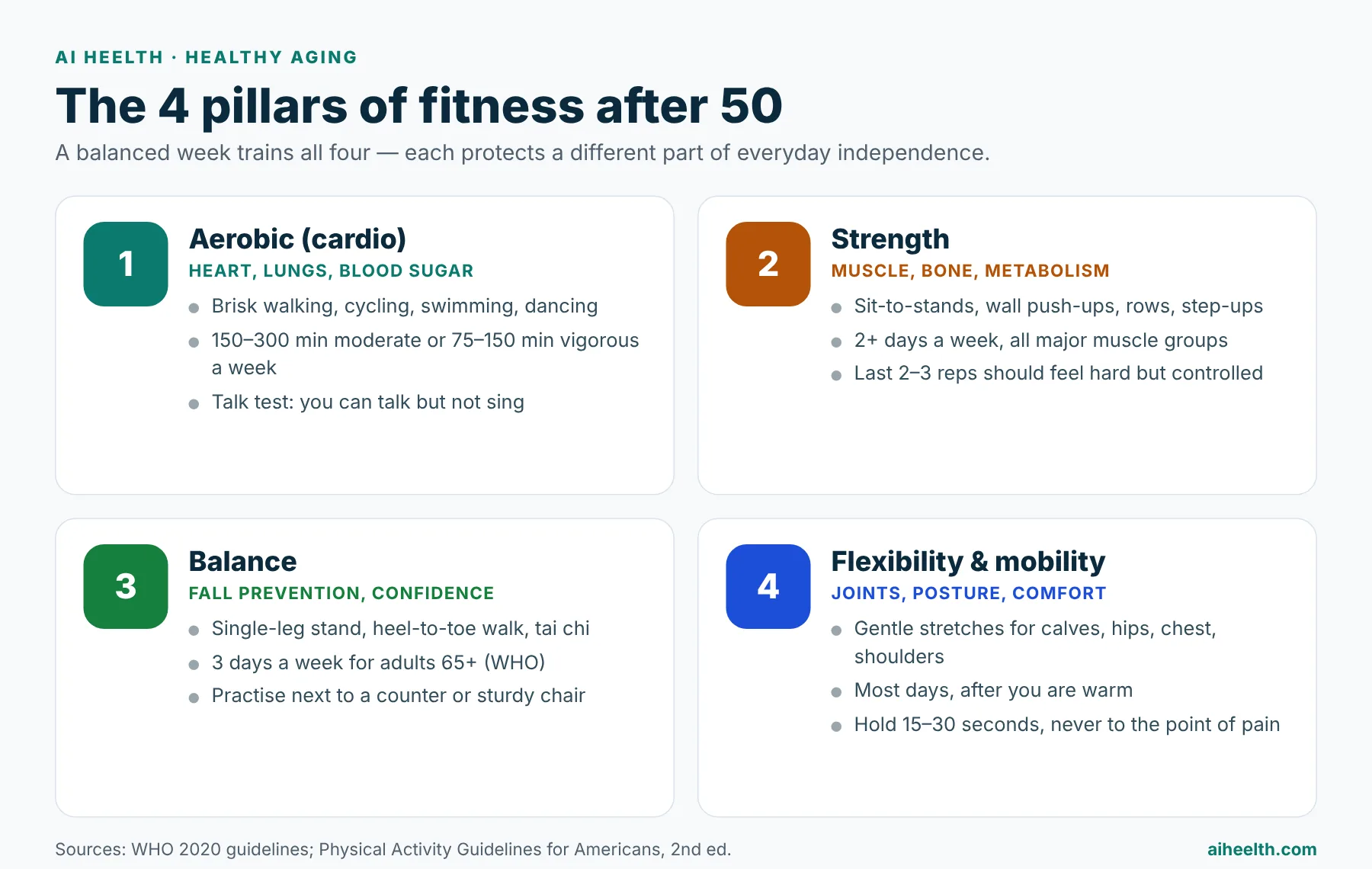
1Aerobic (cardio) exercise Strong evidence
Aerobic activity trains your heart, lungs and blood vessels and helps control blood pressure, cholesterol and blood sugar. Walking is the easiest place to start. Swimming, water aerobics and cycling are gentler on painful knees and hips.
How to start: walk at a comfortable pace for 10 minutes, then add 2–5 minutes each week until you reach 30 minutes. When that feels easy, add short bursts of faster walking (for example, 1 minute fast, 2 minutes easy).
2Strength (resistance) training Strong evidence
Strength training is the most effective way to slow age-related muscle loss. It also loads the bones, improves blood sugar control and makes daily tasks such as climbing stairs, carrying shopping and getting up from a chair easier. You do not need a gym: a sturdy chair, a wall and a resistance band are enough.
How to start: choose 6–8 exercises that cover the legs, hips, back, chest, shoulders and arms. Do 1–2 sets of 8–12 repetitions. The last 2–3 reps should feel challenging while your form stays good. Breathe out on the effort and never hold your breath.
3Balance training Strong evidence for falls
Balance is a skill that fades if it is not practised. Programmes combining balance and strength exercises reduce the rate of falls in older adults, and tai chi has particularly good evidence.
How to start: stand next to a kitchen counter. Try standing on one leg for up to 30 seconds, then switch. Practise heel-to-toe walking along the counter. As you improve, lightly touch the counter with one finger, then not at all.
4Flexibility and mobility Supportive
Stretching does not prevent injuries on its own, but it helps keep joints comfortable and maintains the range of motion you need for reaching, turning and dressing. Yoga and Pilates combine flexibility with strength and balance.
How to start: after a walk, gently stretch your calves, thighs, hips, chest and shoulders. Hold each stretch for 15–30 seconds and breathe normally. Mild tension is fine; pain is not.
A beginner strength routine you can do at home
This 20-minute routine trains every major muscle group with no equipment except a chair and an optional resistance band. Do it on 2–3 non-consecutive days a week.
| Exercise | Main muscles | Reps | Make it easier | Make it harder |
|---|---|---|---|---|
| Sit-to-stand | Thighs, hips | 8–12 | Use your hands on the armrests | Hold a weight or slow the lowering to 3 seconds |
| Wall push-up | Chest, shoulders, arms | 8–12 | Stand closer to the wall | Push up from a kitchen counter |
| Band row | Upper back, biceps | 10–12 | Lighter band | Thicker band or pause 2 seconds |
| Step-up | Thighs, buttocks, balance | 8 each leg | Lower step, hold the rail | Higher step or carry light weights |
| Heel raise | Calves, ankles | 12–15 | Hold the counter with both hands | One leg at a time |
| Overhead press | Shoulders, arms | 8–12 | Seated, light bottles | Standing with dumbbells |
| Bird-dog | Core, lower back | 6 each side | Move only the arms or only the legs | Hold 5 seconds at the top |
Osteoporosis or low bone density? Strength and impact training are still recommended, but avoid loaded forward bending and twisting of the spine (such as sit-ups or toe touches with weight). A physiotherapist can tailor a safe programme for you.
A sample 7-day health and fitness plan for over 50s
This plan meets the WHO and HHS targets with about 3 hours of total activity a week. Swap days to suit your routine, and keep at least one rest day.
| Day | Main session | Time | Extra |
|---|---|---|---|
| Monday | Brisk walk | 30 min | 5 min balance practice |
| Tuesday | Strength routine (above) | 20–25 min | Stretch 5 min |
| Wednesday | Cycling, swimming or brisk walk | 30 min | 5 min balance practice |
| Thursday | Rest or gentle yoga / tai chi | 20 min | Short walks after meals |
| Friday | Strength routine | 20–25 min | 5 min balance practice |
| Saturday | Longer walk, hike or dance class | 40–60 min | Stretch 5 min |
| Sunday | Rest, gardening or a family walk | Any | Plan next week |
Tip: a 10–15 minute walk after meals helps lower the rise in blood sugar after eating, which is useful if you have prediabetes or type 2 diabetes. See our guide on how to control HbA1c naturally.
A 12-week starter progression
If you have been inactive, this gradual build-up lowers the risk of soreness and injury while still reaching the guideline targets by week 12.
| Weeks | Cardio | Strength | Balance | Weekly total |
|---|---|---|---|---|
| 1–2 | 10 min walk, 5 days | 1 set of 4 moves, 2 days | 2 min, 3 days | ~60 min |
| 3–4 | 15 min walk, 5 days | 1 set of 6 moves, 2 days | 3 min, 3 days | ~95 min |
| 5–8 | 20–25 min, 5 days | 2 sets of 6–7 moves, 2 days | 5 min, 3 days | ~140 min |
| 9–12 | 30 min, 5 days (add fast intervals) | 2 sets of 7 moves, 2–3 days | 5–10 min, 3 days | 150–200 min |
How can you test your health and fitness at home?
Two simple tests used by doctors and physiotherapists give you a starting point and a way to track progress every 4–6 weeks.
1. The 30-second chair stand test
Sit in the middle of a straight-backed chair with your arms crossed over your chest. Count how many times you can stand fully and sit back down in 30 seconds. A score below the number in the table suggests below-average leg strength and a higher risk of falls (CDC STEADI).
| Age | Men: below | Women: below |
|---|---|---|
| 60–64 | 14 | 12 |
| 65–69 | 12 | 11 |
| 70–74 | 12 | 10 |
| 75–79 | 11 | 10 |
| 80–84 | 10 | 9 |
| 85–89 | 8 | 8 |
| 90–94 | 7 | 4 |
2. Single-leg balance test
Standing next to a counter, lift one foot and time how long you can balance without holding on, up to 30 seconds. Many healthy adults in their 50s and 60s can manage 20–30 seconds. Under 10 seconds is a sign to add daily balance practice and to mention it to your doctor.
Safety first: do these tests with a counter or another person nearby. Stop if you feel dizzy, unsteady or have any pain.
What should you eat to support fitness after 50?
Good health and fitness depend on what you eat as much as how you move. Exercise builds the stimulus; food supplies the building blocks. The 2025–2030 Dietary Guidelines for Americans, released in January 2026, raised the suggested protein intake to 1.2–1.6 g per kilogram of body weight per day, noting that older and active adults may benefit from the higher end. Spreading it across meals, about 25–30 g each, appears to help muscle repair more than one large protein meal.
| Meal | Example | Approx. protein |
|---|---|---|
| Breakfast | 2 eggs + 1 cup (245 g) plain Greek yogurt | ~35 g |
| Lunch | 1 cup cooked lentils + small chicken breast salad | ~45 g |
| Dinner | 120 g grilled fish + vegetables + brown rice | ~30 g |
| Snack | A handful (30 g) of almonds + a glass of milk | ~14 g |
Use our protein guide to work out your own number, and see the best nuts for brain and heart health for snack ideas.
- Hydration: thirst signals weaken with age. Drink water through the day and before, during and after exercise, especially in hot weather.
- Calcium and vitamin D: support bone strength alongside weight-bearing exercise. Ask your doctor whether you need a test or supplement.
- Fibre and whole foods: vegetables, fruit, legumes and whole grains support gut health and steady energy. See good carbs vs bad carbs and how to improve gut health.
- Limit ultra-processed foods, added sugar (under 10% of calories) and sodium (under 2,300 mg a day).
Kidney disease? Higher protein intakes may not be suitable. Speak with your doctor or a dietitian before increasing protein.
Want to check your energy needs? Try our calorie calculator or BMI calculator.
How do sleep, sitting and recovery affect fitness?
Sleep
Adults need at least 7 hours of sleep a night; for those 65 and over, 7–8 hours is a common recommendation. Muscle repair, blood sugar control and appetite regulation all depend on sleep, and regular daytime activity tends to improve sleep quality.
Sitting
Long, unbroken sitting is linked to poorer health even in people who exercise. A large 2016 analysis in The Lancet (Ekelund and colleagues, over 1 million adults) found that about 60–75 minutes a day of moderate activity appeared to offset the higher death risk linked to high sitting time. Practical fix: stand up and move for 2–3 minutes every 30–60 minutes.
Recovery
Leave at least 48 hours between strength sessions for the same muscle groups. Mild muscle soreness for a day or two is normal after a new exercise; sharp or joint pain is not.
Is it safe to start exercising after 50?
For most people, yes. The benefits of activity far outweigh the risks, and walking is safe for almost everyone. Talk to your doctor before starting vigorous exercise if you have heart disease, diabetes, kidney disease, uncontrolled high blood pressure, or symptoms such as chest discomfort or unusual breathlessness.
| Condition | Key tips |
|---|---|
| High blood pressure | Regular aerobic and strength exercise can lower blood pressure. Breathe out on effort; avoid holding your breath and very heavy lifts. Read high blood pressure: the silent killer. |
| Type 2 diabetes | If you use insulin or sulfonylureas, check glucose before and after exercise and carry fast-acting sugar. Check your feet daily. |
| Knee or hip arthritis | Low-impact cardio (cycling, swimming) and leg strengthening often reduce pain. Some discomfort is acceptable if it settles within 24 hours. |
| Osteoporosis | Strength and balance work are recommended; avoid loaded forward bending and twisting. |
| Heart disease | Ask about a cardiac rehabilitation programme, which provides supervised, structured exercise. |
Stop exercising and seek urgent medical help if you notice:
- chest pain, pressure or tightness, or pain spreading to the arm, jaw or back
- severe shortness of breath, fainting or a racing or irregular heartbeat
- sudden weakness, numbness, confusion or trouble speaking
Learn the less obvious signs in silent heart attack warning signs and heart attack symptoms in women.
Your daily health and fitness checklist
Health and fitness after 50: myths vs facts
| Myth | Fact |
|---|---|
| “It’s too late to build muscle.” | Studies show people in their 70s, 80s and 90s gain strength with resistance training. |
| “Walking is enough.” | Walking is excellent for the heart, but it does not fully protect muscle, bone or balance. Add strength and balance work. |
| “Lifting weights is bad for your joints.” | Well-performed strength training usually reduces joint pain by strengthening the muscles that support the joint. |
| “You need 10,000 steps a day.” | Benefits are seen well below 10,000; for adults 60+, gains level off around 6,000–8,000. |
| “Short sessions don’t count.” | Current guidelines count activity of any length. Three 10-minute walks equal one 30-minute walk. |
Key takeaways
- Aim for 150–300 minutes of moderate activity a week; any amount is better than none.
- Strength train at least 2 days a week to protect muscle, bone and independence.
- From 65, add balance training about 3 days a week to lower the risk of falls.
- Around 7,000 steps a day is linked to large health benefits; 10,000 is not required.
- Support training with enough protein, water and 7+ hours of sleep, and sit less.
- Start low, build up over 12 weeks, and see a doctor about any warning symptoms. Small, steady steps are the foundation of lasting health and fitness.
Frequently asked questions
What is the best exercise for health and fitness after 50?
There is no single best exercise. The best plan combines brisk walking or another aerobic activity, strength training twice a week, and balance work. The one you will do consistently is the right one for you.
How much exercise should a 60-year-old do?
At least 150 minutes of moderate activity (or 75 minutes of vigorous activity) a week, muscle-strengthening on 2 or more days, and from age 65, balance-focused activity on about 3 days a week.
Can you get fit after 50 if you have never exercised?
Yes. Beginners often see the fastest improvements. Start with 10-minute walks and simple chair exercises, then increase gradually over 8–12 weeks. Check with your doctor first if you have a heart condition or other chronic illness.
How many steps a day should a 50-year-old walk?
Research links about 7,000 steps a day with substantially lower risks of early death, heart disease and dementia compared with 2,000 steps. Adults under 60 see continued benefits up to about 8,000–10,000 steps.
Is walking enough exercise after 50?
Walking covers your aerobic needs, but you also need strength training to slow muscle and bone loss, and balance exercises to reduce falls.
How many days a week should I strength train after 50?
At least 2 non-consecutive days a week, working all major muscle groups. Three days can give extra benefit if you recover well.
How much protein do I need after 50 to build muscle?
The 2025–2030 Dietary Guidelines for Americans suggest 1.2–1.6 g of protein per kg of body weight daily, spread across meals. People with kidney disease should ask their doctor first.
References
- World Health Organization. WHO Guidelines on Physical Activity and Sedentary Behaviour. Geneva: WHO; 2020.
- U.S. Department of Health and Human Services. Physical Activity Guidelines for Americans, 2nd edition. 2018; and HHS/ODPHP notice on the planned 2027 supplement on steps and muscle-strengthening (2026).
- Ding D, Nguyen B, Nau T, et al. Daily steps and health outcomes in adults: a systematic review and dose-response meta-analysis. Lancet Public Health. 2025. PubMed 40713949.
- Paluch AE, Bajpai S, Bassett DR, et al. Daily steps and all-cause mortality: a meta-analysis of 15 international cohorts. Lancet Public Health. 2022;7(3):e219–e228.
- Ekelund U, Steene-Johannessen J, Brown WJ, et al. Does physical activity attenuate, or even eliminate, the detrimental association of sitting time with mortality? Lancet. 2016;388:1302–1310.
- Tanaka H, Monahan KD, Seals DR. Age-predicted maximal heart rate revisited. J Am Coll Cardiol. 2001;37(1):153–156.
- Centers for Disease Control and Prevention. STEADI: Stopping Elderly Accidents, Deaths and Injuries (30-Second Chair Stand assessment); older adult falls data.
- U.S. Department of Agriculture and HHS. Dietary Guidelines for Americans, 2025–2030. January 2026.