
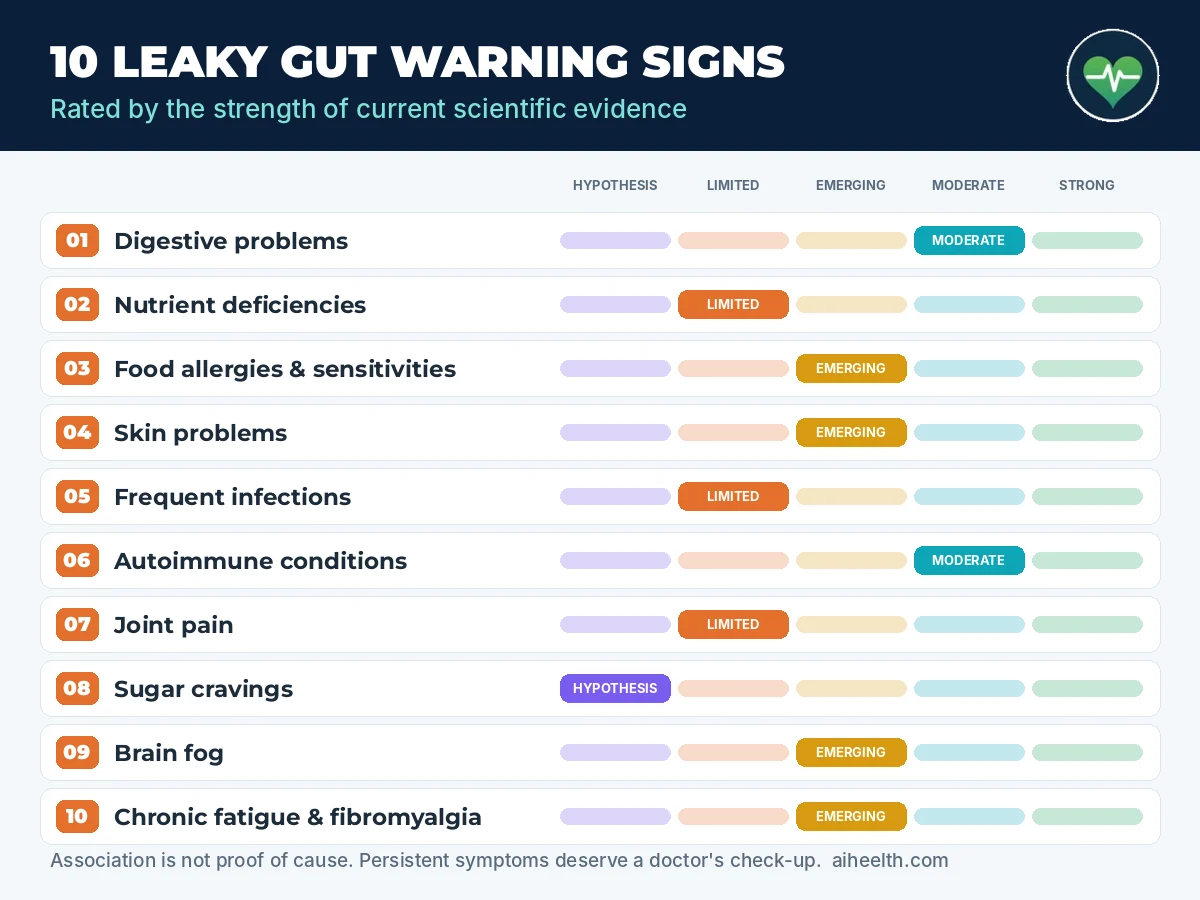
Increased intestinal permeability (“leaky gut”) is real and measurable in research, but “leaky gut syndrome” is not a recognised diagnosis and has no validated test. Of the 10 signs people link to it, the evidence is moderate for digestive symptoms and autoimmune conditions (strongest for coeliac disease), emerging for allergies, skin, brain fog and fatigue, limited for nutrient deficiencies, infections and joint pain, and only a hypothesis for sugar cravings. Persistent symptoms deserve a doctor’s check-up, not guesswork.
- A leakier gut barrier is a real finding in research, but it is usually a sign of another condition (such as coeliac disease or IBD), not a stand-alone disease.
- No home test, IgG panel or “zonulin kit” can diagnose “leaky gut syndrome”.
- Most symptoms blamed on leaky gut have common, testable and treatable causes: start there.
- The best-supported habits are simple: about 30 g of fibre a day, less alcohol, no smoking and no unneeded NSAID painkillers.
- Over 50? New bowel changes, blood in your stool or weight loss need a doctor, not a gut protocol.
What is leaky gut, really?
“Leaky gut” is the everyday name for increased intestinal permeability: a gut lining that lets more substances pass between its cells than it should. Your small intestine is lined by a single layer of cells. Protein seals called tight junctions hold neighbouring cells together and act like smart gates, letting water and nutrients through while keeping most bacteria and large food particles out.
- Increased intestinal permeability
- A measurable change in the gut barrier, seen in research and in conditions such as coeliac disease and inflammatory bowel disease. Its role in many other conditions is still being studied [1].
- “Leaky gut syndrome”
- The popular idea that a leaky barrier is itself the hidden cause of many symptoms. It is not a recognised medical diagnosis, and no validated test exists for it [2][4].
- Zonulin
- A protein that loosens tight junctions. In coeliac disease, gluten triggers its release in genetically susceptible people [5].
One key point from the leading clinical review: it is still unproven that restoring barrier function improves symptoms in gut or whole-body diseases [1]. That is why this guide rates each claim rather than treating them all as fact.
How did we rate the evidence?
Each sign gets one of five ratings based on the type and quality of human research behind the link with gut permeability. A link (association) is not the same as proof that a leaky gut causes the symptom.
| Rating | What it means |
|---|---|
| STRONG | Consistent human evidence, accepted in clinical guidelines. |
| MODERATE | Repeated human studies show a link; cause and effect not fully settled. |
| EMERGING | Promising but early: small studies, mixed results, active research. |
| LIMITED | Little good evidence for leaky gut as the cause; other explanations fit better. |
| HYPOTHESIS | An interesting idea, mostly from animal studies; not shown in people. |
Table 1. The AIheelth evidence scale used in this guide.
What are the 10 leaky gut warning signs, and how strong is the evidence?
Tap a rating to filter the table. Each row links to the full explanation.
| # | Sign | Rating | What science says | Best next step |
|---|---|---|---|---|
| 1 | Digestive problems | MODERATE | Higher permeability seen in some IBS and IBD; direction unclear | See a doctor if it lasts more than a few weeks |
| 2 | Nutrient deficiencies | LIMITED | Absorption suffers when villi are damaged, not from “leakiness” itself | Blood test before supplements |
| 3 | Food allergies and sensitivities | EMERGING | Barrier and food tolerance are linked, especially early in life | Food diary; skip IgG tests |
| 4 | Skin problems | EMERGING | Gut-skin axis is real; leaky gut not proven to cause skin disease | Proven skin treatment first |
| 5 | Frequent infections | LIMITED | No good evidence leaky gut alone causes more colds | Check sleep, stress, diabetes, vitamin D |
| 6 | Autoimmune conditions | MODERATE | Strong for coeliac disease; still emerging for others | Keep your specialist’s treatment |
| 7 | Joint pain | LIMITED | No strong link to osteoarthritis; early work in rheumatoid arthritis | Activity, strength, healthy weight |
| 8 | Sugar cravings | HYPOTHESIS | Microbes steering cravings is an idea, mostly from animals | Regular meals with protein and fibre |
| 9 | Brain fog | EMERGING | Gut-brain axis is real; leaky gut causing brain fog is not proven | Check sleep, thyroid, B12, mood |
| 10 | Chronic fatigue and fibromyalgia | EMERGING | Small studies show associations, not cause | Rule out anaemia, thyroid, sleep apnoea |
Table 2. Summary of the 10 signs. Ratings reflect evidence for a link with intestinal permeability, not whether the symptom matters. Every persistent symptom deserves attention.
01Can leaky gut cause bloating and digestive problems?
MODERATEShort answer: Possibly, in part. Studies find increased gut permeability in some people with irritable bowel syndrome (IBS) and inflammatory bowel disease (IBD), but researchers still don’t know which comes first. Inflammation may weaken the barrier, and a weaker barrier may add to symptoms [1].
Bloating, gas, diarrhoea and constipation are the most common reasons people search for leaky gut. They are real and worth taking seriously, but the same symptoms come from many causes that have simple, proven treatments.
What else could it be?
- Food intolerance (for example lactose)
- Coeliac disease
- Small intestinal bacterial overgrowth (SIBO)
- Infections or medicines
- IBS or IBD
What to do
- Keep a 2-week food and symptom diary
- See a doctor if changes last more than a few weeks
- Ask about blood and stool tests for treatable causes
02Does leaky gut cause nutrient deficiencies?
LIMITEDShort answer: Not directly. Nutrients are absorbed by tiny finger-like villi in the small intestine. When villi are damaged, as in coeliac disease, untreated Crohn’s disease or bacterial overgrowth, absorption suffers. A leakier barrier often comes along with these conditions, but it is a fellow traveller, not the root cause.
The deficiencies that matter most are iron, vitamin B12, folate, vitamin D, magnesium and zinc. Signs can include tiredness, pale skin, tingling in the hands or feet, muscle cramps and frequent infections.
Over 50? Low B12 becomes more common with age, and long-term use of metformin or acid-reducing medicines (such as proton pump inhibitors) is linked to lower B12 levels [9][10]. A simple blood test can check.
Common causes
- Coeliac disease, Crohn’s disease
- Low intake (restrictive diets)
- Medicines: metformin, acid reducers
- Heavy periods (iron)
What to do
- Ask for a blood test before supplementing
- Avoid high-dose iron, zinc or vitamin D without advice: too much can harm
03Is leaky gut linked to food allergies and sensitivities?
EMERGINGShort answer: It’s an active research area. A healthy gut barrier and a well-trained immune system help the body tolerate food, and disruption, especially early in life, may make reactions more likely. But this is no reason to fear or cut out lots of foods.
| Food allergy | Food intolerance | |
|---|---|---|
| Speed | Usually within minutes | Hours, slower |
| Typical symptoms | Hives, swelling, vomiting, trouble breathing | Bloating, discomfort (for example after dairy) |
| Danger | Can be life-threatening | Uncomfortable, not dangerous |
| Right test | Allergist: history plus skin-prick or IgE tests | Food diary and guided elimination |
Table 3. Food allergy and food intolerance are different problems with different tests.
Watch out
- Unnecessary diets can become too restrictive
- Going gluten-free first can make coeliac tests falsely normal
What to do
- Keep a food and symptom diary
- Try a short elimination diet, ideally with a dietitian
- Keep eating gluten in more than one meal a day for 6 weeks before coeliac testing [8]
04Can leaky gut cause skin problems like acne, eczema or rosacea?
EMERGINGShort answer: The gut-skin axis is real, but leaky gut is not proven to cause skin disease. Studies link gut microbes and inflammation with eczema, rosacea, psoriasis and acne. For example, people with rosacea are more likely to have SIBO than people without it [11].
Main drivers
- Genetics and hormones
- Skin barrier and skin microbes
- Inflammation, stress, triggers
What to do
- Start with proven skin treatments (pharmacist, GP or dermatologist)
- Eat plenty of vegetables, fruit, whole grains and oily fish; fewer ultra-processed foods
05Does leaky gut weaken your immune system?
LIMITEDShort answer: A large share of your immune cells live in and around the gut, and barrier problems and immune activation are connected. But there is no good evidence that a leaky gut alone makes healthy people catch more colds.
Common causes of frequent infections
- Poor sleep and high stress
- Diabetes, smoking
- Low vitamin D
- Some medicines; getting older
What to do
- Frequent, severe or lingering infections need a check-up
- Keep vaccinations up to date
- Prioritise sleep, activity and a varied diet
06Is leaky gut connected to autoimmune disease?
MODERATEShort answer: For coeliac disease, yes: it is the clearest example in medicine. In people with the right genes, gluten triggers zonulin, which loosens tight junctions; gluten fragments slip through and the immune system attacks the small intestine [5]. For type 1 diabetes, IBD, rheumatoid arthritis and lupus, barrier changes are being studied, but a link is not the same as a cause.
Still unknown
- Whether barrier changes start these diseases or follow them
What to do
- Don’t swap your treatment for a “gut-healing” plan
- Keep working with your specialist
- Diet and lifestyle can support, not replace, treatment
07Can leaky gut cause joint pain or osteoarthritis?
LIMITEDShort answer: There is no strong evidence that osteoarthritis is common because of leaky gut. Osteoarthritis is driven mainly by age, joint injury or overuse, genes and excess body weight [13]. For inflammatory arthritis such as rheumatoid arthritis, the gut microbiome is being studied, mostly in animals and small human studies.
See a doctor promptly if
- Joints are hot or swollen
- Morning stiffness lasts more than an hour
What helps (proven)
- Stay active; strength training
- Keep a healthy weight: even small weight loss eases knee load
08Do gut bacteria cause sugar cravings?
HYPOTHESISShort answer: It’s a fascinating idea, but still a hypothesis. Researchers have proposed that some gut microbes may influence what we crave through the vagus nerve and hormones [14], but it is mostly tested in animals. Diet also reshapes gut microbes, sometimes within days, so the arrow likely points both ways.
Your body holds roughly 38 trillion bacteria, about as many as its own cells [3]. What shapes cravings far more reliably: sleep, stress, blood sugar swings, habits and ultra-processed foods designed to be hard to resist.
What helps
- Regular meals with protein and fibre
- 7 to 9 hours of sleep
- Keep sweets out of easy reach
- More beans, lentils, oats, vegetables, nuts and seeds; tastes adjust over a few weeks
09Can leaky gut cause brain fog?
EMERGINGShort answer: The gut-brain axis is real: gut and brain communicate through nerves, hormones, the immune system and microbial substances. Studies have found signs of bacterial products in the blood of some people with depression [15]. But leaky gut causing brain fog is not proven.
Treatable causes of brain fog
- Poor sleep, sleep apnoea
- Thyroid problems, low B12, anaemia
- Depression, menopause
- Medicine side effects
What to do
- Start with a check-up
- New memory problems that are getting worse, especially after 60: see a doctor soon [16]
10Is leaky gut behind chronic fatigue and fibromyalgia?
EMERGINGShort answer: It’s an active research area, but the studies are small and show association, not cause. Research in ME/CFS (chronic fatigue syndrome) has found markers of bacterial products in the blood and gut microbe changes, and one small study found altered gut permeability in fibromyalgia [17].
Rule out first
- Anaemia, underactive thyroid
- Diabetes, sleep apnoea
- Depression, vitamin deficiencies
What helps
- Fibromyalgia: gentle, gradually increased exercise, sleep habits, talking therapies
- ME/CFS: stay within your energy limit; pushing through can make symptoms worse
Leaky gut myths vs facts
| Myth | Fact |
|---|---|
| “Leaky gut syndrome” is an official diagnosis. | It isn’t. Increased intestinal permeability is real, but there is no validated test for “leaky gut syndrome” [2][4]. |
| A home IgG test shows which foods to avoid. | IgG reflects foods you eat. Allergy experts recommend against it [6][7]. |
| Your skin flushes out gut toxins. | The liver and kidneys clear waste. |
| Leaky gut causes osteoarthritis. | Age, injury, genes and weight drive osteoarthritis [13]. |
| Gut toxins cause ADHD. | Not proven. |
| A gut-healing supplement protocol cures fatigue. | No protocol is proven; restoring the barrier hasn’t been shown to fix symptoms [1]. |
Table 4. Common leaky gut claims, checked against current evidence.
When should you see a doctor? (Red flags)
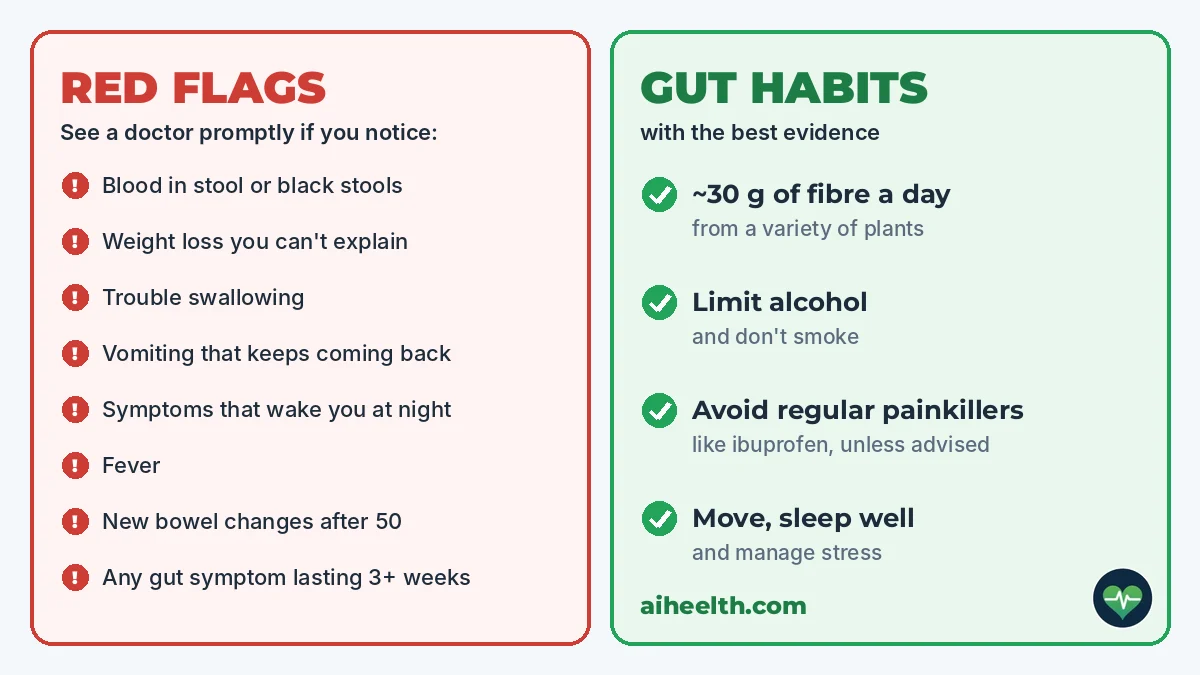
See a doctor promptly if you notice:
- Blood in your stool, or black stools
- Weight loss you can’t explain
- Trouble swallowing
- Vomiting that keeps coming back
- Symptoms that wake you at night, or fever
- New bowel changes after 50, especially with a family history of bowel cancer, coeliac disease or IBD
- Any gut symptom lasting 3 weeks or more [20]
Emergency: call 999 (or your local emergency number) if you are bleeding heavily or non-stop from your bottom, or see large blood clots [20].
Over 50? Three checks that matter more than any gut protocol
- Bowel cancer screening: take part when you are invited (most programmes start between 45 and 50). A screening test is for people without symptoms; if you have symptoms, see a doctor instead of waiting.
- Vitamin B12: ask for a blood test if you take metformin or an acid-reducing medicine long term, or have tingling, tiredness or memory changes [9][10].
- Medicine review: regular NSAIDs, some diabetes medicines, iron tablets and antibiotics can all upset the gut. Ask your pharmacist to review everything you take.
What actually supports a healthy gut barrier?
The habits with the best evidence are simple: plenty of varied fibre, little alcohol, no smoking, avoiding regular painkillers you don’t need, daily movement, good sleep and managing stress.
| Habit | Why it helps | Easy start |
|---|---|---|
| ~30 g fibre a day | Feeds beneficial microbes; UK adults average about 20 g [12] | Add a portion of beans or oats daily |
| Limit alcohol, don’t smoke | Both irritate the gut and harm overall health | Alcohol-free days each week |
| Avoid regular NSAIDs (e.g. ibuprofen) unless advised | NSAIDs increase intestinal permeability [1] | Ask your pharmacist about alternatives |
| Move, sleep, manage stress | Supports gut, mood and immunity | A 10-minute walk after meals |
Table 5. Gut-friendly habits with the best evidence. Increase fibre gradually and drink enough fluids.
Free tools
Fibre tracker: are you near 30 g a day?
Enter how many portions you eat on a typical day. Fibre values are typical averages.
0 g of 30 g
Doctor checklist: what to ask about your symptoms
Tick what applies. You’ll get a printable list of questions and checks to discuss with your doctor. This is not a diagnosis.
Frequently asked questions
Is leaky gut real?
Increased intestinal permeability is real and is measured in research and seen in conditions like coeliac disease and IBD. “Leaky gut syndrome”, the idea that it secretly causes many symptoms, is not a recognised diagnosis [2][4].
Is there a test for leaky gut?
There is no validated test for “leaky gut syndrome” in routine care [2]. Research labs use sugar-absorption tests and biopsies, but these are not diagnostic tools for everyday symptoms. Your doctor will test for treatable causes instead.
What is the most common sign linked to leaky gut?
Digestive symptoms such as bloating, gas, diarrhoea and constipation. The evidence for a link is moderate, but these symptoms have many causes, so persistent symptoms should be checked by a doctor.
Can you heal a leaky gut?
When a specific disease causes it, treating that disease helps; for example, a strict gluten-free diet in coeliac disease. For everyone else, it is unproven that “repairing” the barrier improves symptoms [1]. Fibre-rich eating, limiting alcohol, not smoking and avoiding unneeded NSAIDs support overall gut health.
Do probiotics or glutamine fix leaky gut?
Evidence is limited and inconsistent. Some probiotics may help specific conditions, but none is proven to cure “leaky gut”. Talk to a doctor or registered dietitian before starting supplements.
Should I go gluten-free to help my gut?
Not before testing. If coeliac disease is possible, keep eating gluten in more than one meal a day for at least 6 weeks before the blood test, or the result may be falsely normal [8].
Are IgG food sensitivity tests worth it?
No. Food-specific IgG mostly shows that you eat a food. Allergy societies advise against using these tests [6][7].
When should I worry about gut symptoms?
See a doctor promptly for blood in your stool or black stools, unexplained weight loss, trouble swallowing, repeated vomiting, symptoms that wake you at night, fever, new bowel changes after 50, or any gut symptom lasting 3 weeks or more [20].
How we create and review content
- Research: we start from clinical guidelines, systematic reviews and peer-reviewed studies.
- Rate: each claim gets an evidence rating, so you can see what is proven and what is not.
- Check: every claim is matched to the source cited next to it; we never cite a study for more than it shows.
- Update: we re-check sources regularly and show the last-reviewed date at the top.
Sources
- Camilleri M. Leaky gut: mechanisms, measurement and clinical implications in humans. Gut. 2019;68(8):1516-1526. doi:10.1136/gutjnl-2019-318427
- Lacy BE, Wise JL, Cangemi DJ. Leaky gut syndrome: myths and management. Gastroenterol Hepatol (N Y). 2024;20(5):264-272. PMC11345991
- Sender R, Fuchs S, Milo R. Revised estimates for the number of human and bacteria cells in the body. PLoS Biol. 2016;14(8):e1002533. doi:10.1371/journal.pbio.1002533
- Cleveland Clinic. Leaky gut syndrome. my.clevelandclinic.org
- Fasano A. Zonulin and its regulation of intestinal barrier function. Physiol Rev. 2011;91(1):151-175. doi:10.1152/physrev.00003.2008
- American Academy of Allergy, Asthma & Immunology. The myth of IgG food panel testing. aaaai.org
- Carr S et al. CSACI position statement on the testing of food-specific IgG. Allergy Asthma Clin Immunol. 2012;8:12. doi:10.1186/1710-1492-8-12
- NICE. Coeliac disease: recognition, assessment and management (NG20): when you should be tested. nice.org.uk
- Aroda VR et al. Long-term metformin use and vitamin B12 deficiency in the Diabetes Prevention Program Outcomes Study. pmc.ncbi.nlm.nih.gov/articles/PMC4880159
- NIH Office of Dietary Supplements. Vitamin B12 fact sheet for consumers. ods.od.nih.gov
- Parodi A et al. Small intestinal bacterial overgrowth in rosacea: clinical effectiveness of its eradication. Clin Gastroenterol Hepatol. 2008;6(7):759-764. doi:10.1016/j.cgh.2008.02.054
- NHS. How to get more fibre into your diet. nhs.uk
- CDC. Osteoarthritis. cdc.gov
- Alcock J, Maley CC, Aktipis CA. Is eating behavior manipulated by the gastrointestinal microbiota? BioEssays. 2014;36(10):940-949. doi:10.1002/bies.201400071
- Maes M, Kubera M, Leunis JC. The gut-brain barrier in major depression. Neuro Endocrinol Lett. 2008;29(1):117-124. PMID: 18283240
- NHS. Memory loss (amnesia). nhs.uk
- Goebel A et al. Altered intestinal permeability in patients with primary fibromyalgia and in patients with complex regional pain syndrome. Rheumatology. 2008;47(8):1223-1227. doi:10.1093/rheumatology/ken140
- Macfarlane GJ et al. EULAR revised recommendations for the management of fibromyalgia. Ann Rheum Dis. 2017;76(2):318-328. doi:10.1136/annrheumdis-2016-209724
- NICE. ME/CFS: diagnosis and management (NG206). nice.org.uk
- NHS. Bowel cancer: symptoms. nhs.uk