
Looking for foods that help you lose fat? Here is the honest version: no food melts fat by itself, but some foods make a calorie deficit far easier to live with. This guide ranks 10 of them by the strength of the evidence, gives you a portion for each, and adds a fat-loss plate, a sample day, a myth check and a free protein calculator.
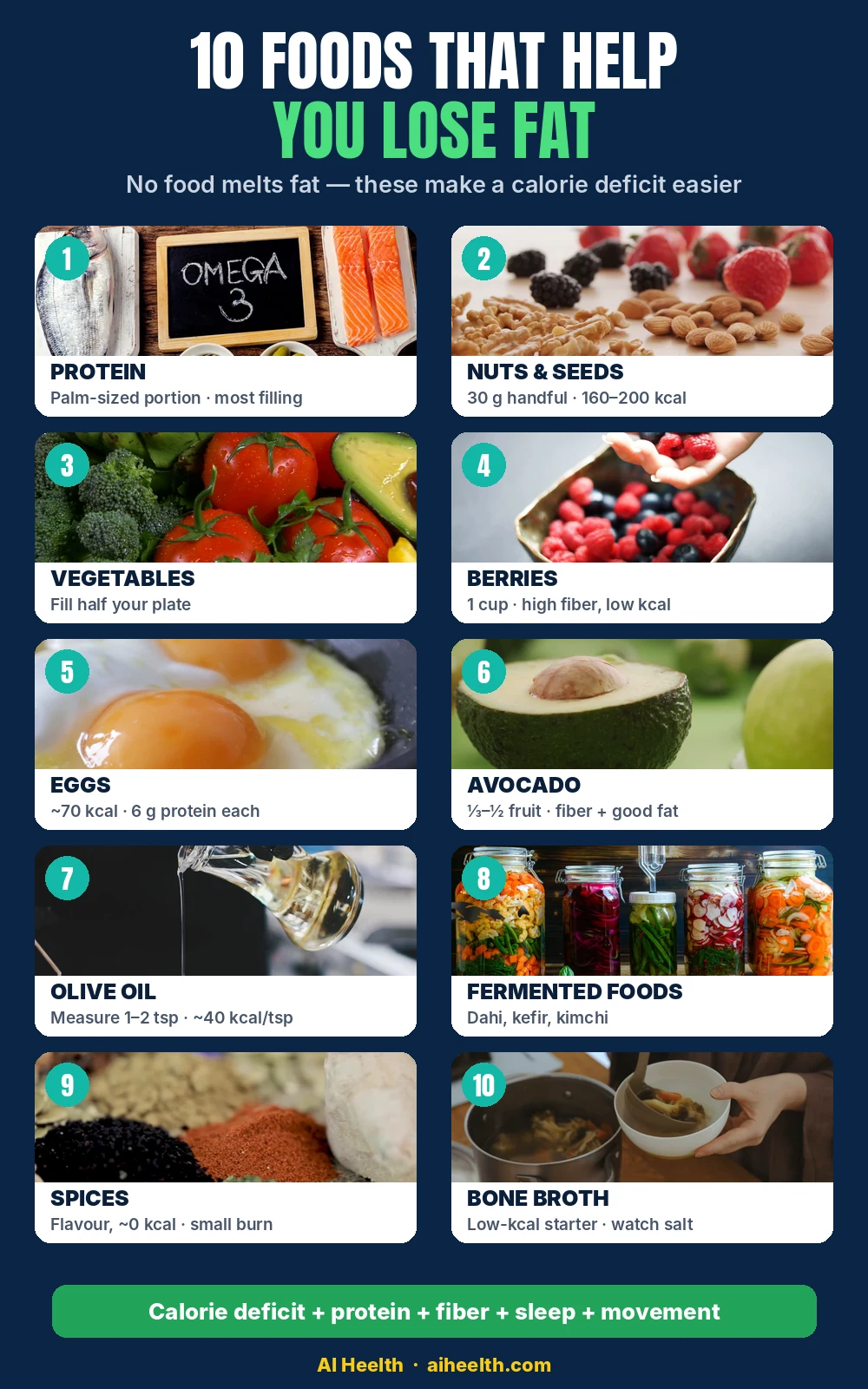
The most useful foods for fat loss are protein foods, non-starchy vegetables, nuts and seeds, berries, eggs, avocado, olive oil, fermented foods, spices and broth. None of them burns fat directly. They help by filling you up for fewer calories, protecting muscle while you lose weight and curbing cravings, which makes the calorie deficit that drives fat loss easier to sustain.
- Body fat falls only when you use more energy than you eat, week after week. Food choices make that easier; they don’t replace it.
- Protein is the most filling nutrient and the most expensive one for your body to process.
- Vegetables and berries give large, satisfying portions for very few calories.
- Nuts, avocado and oils are healthy but energy-dense, so measure them.
- Claims about “fat-burning” spices, coconut oil and bone broth are overstated. Each one is fact-checked below.
In this guide
- Can any food burn fat?
- The 10 foods at a glance
- Protein foods
- Nuts and seeds
- Non-starchy vegetables
- Berries
- Eggs
- Avocado
- Healthy oils
- Fermented foods
- Spices
- Bone broth
- Build a fat-loss plate
- Sample 1-day menu
- Protein calculator
- Fat loss after 50
- Myths vs facts
- Who should be careful
- Shopping checklist
- FAQs
Can any food actually burn fat?
No. No single food burns body fat; fat loss comes from a sustained calorie deficit. What food can change is how hard that deficit feels. Some foods fill you up on fewer calories, some protect muscle while the scale moves, and a few slightly raise the energy you spend after a meal.
That last effect is the thermic effect of food, the energy used to digest, absorb and store a meal. It varies a lot by nutrient. Roughly 20–30% of protein’s calories go into processing it, against about 5–10% for carbohydrate and 0–3% for fat.
Keep it in perspective: digestion accounts for only about a tenth of daily energy use. Fullness, muscle protection and fewer cravings matter more. The NHS suggests aiming for about 0.5–1 kg (1–2 lb) of weight loss a week.
The 10 foods that help you lose fat, at a glance
Protein foods, vegetables and nuts have the strongest evidence; spices and bone broth the weakest. Calories are approximate and change with brand, variety and cooking method.
| Food | Smart portion | ≈ Calories | How it helps | Evidence |
|---|---|---|---|---|
| Protein foods (fish, chicken, daal, dahi) | Palm-sized, 100–120 g cooked | 150–250 | Most filling; protects muscle | Strong |
| Non-starchy vegetables | Half your plate | 25–60 per cup | Volume and fiber for few calories | Strong |
| Nuts and seeds | 30 g (small handful) | 160–200 | Protein, fiber and good fat together | Strong |
| Berries | 1 cup | 50–85 | Sweet taste, high fiber | Moderate |
| Eggs | 1–2 eggs | ~70 each | Complete protein at low cost | Moderate |
| Avocado | ⅓–½ medium | 110–160 | Fiber plus monounsaturated fat | Moderate |
| Extra virgin olive oil | 1–2 tsp per meal | ~40 per tsp | Flavor and heart-friendly fat | Moderate |
| Fermented foods (dahi, kefir, kimchi) | 1 cup / ½ cup | 20–150 | Gut diversity; yogurt adds protein | Emerging |
| Spices (chilli, ginger, cinnamon) | To taste | 0–10 | Flavor without calories | Emerging |
| Bone broth / yakhni | 1 cup | 30–50 | Warm, light starter | Limited |
How we grade evidence: Strong = consistent human trials and systematic reviews. Moderate = good human data with smaller or mixed effects. Emerging = early or short-term human studies. Limited = little direct human evidence on weight.
1Protein foods: why does protein help you lose fat?
Protein helps because it keeps hunger away longest and protects muscle while you eat less. It also has the largest thermic effect of the three macronutrients. When protein is too low during a diet, more of the weight you lose comes from muscle, which lowers strength and daily energy use, a bigger problem after 50.
Good choices: oily fish (salmon, sardines, mackerel), other fish, chicken, lean meat, eggs, plain yogurt or dahi, paneer in moderation, tofu, lentils (daal), chickpeas (chana) and beans. A cup of cooked lentils gives about 18 g of protein and 15 g of fiber.
How much? The Dietary Guidelines for Americans 2025–2030, released in January 2026, advise putting protein at every meal and aiming for about 1.2–1.6 g per kg of body weight a day. For people over 65, the PROT-AGE group recommends at least 1.0–1.2 g/kg, and 1.2–1.5 g/kg for active people or those with chronic illness (except severe kidney disease). Try the calculator below or read how much protein you need.
2Nuts and seeds: do they make you gain weight?
No. In sensible portions, nuts are not linked to weight gain. A 2021 meta-analysis pooled 6 cohort studies of almost 570,000 people and 86 randomized trials. Regular nut eaters had a 7% lower risk of becoming overweight or obese, and the trials found no effect on body weight. The mix of protein, fiber and unsaturated fat in nuts keeps you satisfied for hours.
Watch the portion: 30 g (about 23 almonds) carries roughly 160–200 calories. Portion them into small boxes instead of eating from the packet. Good picks include unsalted almonds, walnuts, pistachios, peanuts, and chia, flax or pumpkin seeds. See our guide to the best nuts for brain and heart health.
3Non-starchy vegetables: the easiest fat-loss win
Vegetables let you fill a big plate for very few calories. Their water and fiber add bulk, slow you down and feed helpful gut bacteria. Broccoli, spinach, cabbage, cauliflower, cucumber, tomato, peppers, okra (bhindi), bottle gourd (lauki), tori and leafy greens all qualify.
Potatoes, corn and peas are nutritious starchy vegetables, but count them in the carb quarter of your plate.
4Berries: a sweet fix for fewer calories
Berries handle a sweet craving with lots of fiber and few calories. A cup of raspberries has about 64 calories and 8 g of fiber. Strawberries, blueberries, blackberries and local fruits such as jamun and falsa work well too.
Their deep colors come from anthocyanins, plant pigments that studies link to better metabolic health. Frozen berries with no added sugar are just as useful and often cheaper.
5Eggs: low-cost, complete protein
Eggs deliver high-quality protein for very few calories. A large egg has about 70 calories and 6 g of protein. The yolk supplies choline, which the liver needs to process fat normally, plus lutein and zeaxanthin, linked to eye health.
An egg breakfast tends to keep people fuller than one built on refined carbs. Boil, poach or scramble with little oil, and pair with vegetables instead of a paratha.
6Avocado: filling fat and fiber
Avocado makes a meal more satisfying through fiber and monounsaturated fat. Half a medium avocado has around 160 calories and about 7 g of fiber, plus potassium, which supports healthy blood pressure.
Use it in place of other fats, such as butter on toast or a creamy dressing, not on top of them.
7Healthy oils: which oil is best for weight loss?
Extra virgin olive oil is the best everyday pick, but every oil is calorie-dense. All oils carry about 120 calories per tablespoon, so how much you pour matters more than which bottle you choose. A little oil also helps you absorb vitamins A, D, E and K from vegetables.
| Fat | Main fat type | Verdict |
|---|---|---|
| Extra virgin olive oil | Monounsaturated | Best everyday choice; strongest heart evidence |
| Canola, mustard, sunflower, avocado oil | Mostly unsaturated | Reasonable for cooking in measured amounts |
| Coconut oil | Saturated (mostly lauric acid) | Use sparingly; raises LDL cholesterol |
| Desi ghee, butter, vanaspati | Saturated (vanaspati may contain trans fat) | Limit ghee and butter; avoid vanaspati |
8Fermented foods: good for your gut, not a shortcut
Fermented foods support a more diverse gut microbiome, but their direct effect on weight is still unclear. In a 2021 Stanford trial, adults who ate more fermented foods for 10 weeks gained gut microbe diversity and had lower markers of inflammation.
Plain yogurt (dahi) and kefir also bring protein, so they are the most useful picks for fat loss. Kimchi, sauerkraut, unsweetened lassi and kanji count too. See our guide to the best fermented foods for gut health.
9Spices: do chilli, ginger or cinnamon burn fat?
Spices have a real but tiny effect on fat burning. A 2018 meta-analysis of 9 human studies found capsaicin, the compound that makes chillies hot, raised energy use by about 60 calories a day. The effect showed up in people with a BMI over 25 but not in leaner people, and many studies used doses above normal cooking. Their real value is taste: they make healthy food something you want to eat.
Lal mirch, haldi, adrak, zeera and dalchini can turn plain vegetables, daal and fish into meals you look forward to.
10Bone broth (yakhni): a light, warming starter
Bone broth helps mainly as a warm, low-calorie starter that takes the edge off hunger. A cup before dinner may make overeating less likely. Homemade chicken or mutton yakhni works as well as shop-bought broth.
How do you build a fat-loss plate?
Fill half your plate with vegetables, a quarter with protein and a quarter with whole grains or starchy carbs, then add a thumb-sized portion of fat. It is the simplest way to combine the foods that help you lose fat into one meal. The layout cuts calories without leaving you hungry, and your hand works as a measuring tool wherever you eat.
What does a fat-loss day of eating look like?
Here is a sample day of about 1,500 calories that uses all ten foods that help you lose fat. It supplies roughly 90 g of protein and 35–40 g of fiber. Your own needs may be higher or lower; estimate them with our calorie calculator.
| Meal | What to eat | ≈ kcal |
|---|---|---|
| Breakfast | 2 boiled or poached eggs, 1 slice whole-grain toast, spinach cooked in 1 tsp olive oil, tea without sugar | 275 |
| Mid-morning | 170 g plain low-fat dahi with 1 cup berries | 165 |
| Lunch | 1 cup daal, large cucumber-tomato salad with 1 tsp olive oil, 1 small whole-wheat roti | 410 |
| Snack | 20 g almonds and 1 apple | 210 |
| Dinner | 1 cup chicken yakhni, 120 g grilled fish with chilli and ginger, roasted vegetables in 1 tsp oil, ½ cup brown rice | 470 |
| Total | About 90 g protein, 35–40 g fiber, under 10 g added sugar per meal | ≈1,530 |
How much protein do you need to lose fat? Free calculator
Most adults losing fat should aim for about 1.2–1.6 g of protein per kg of body weight a day, spread across meals. Enter your details for a personal range, a per-meal target and food examples.
Daily protein target for fat loss
Based on the 2025–2030 Dietary Guidelines and PROT-AGE. For guidance only; nothing is sent or stored online.
Fat loss after 50: what changes?
After 50, the priority shifts from losing weight fast to losing fat while keeping muscle. Muscle naturally declines with age, and a diet without enough protein or strength work speeds that up. Losses in strength raise the risk of falls and loss of independence.
- Get protein at every meal, around 25–30 g, from eggs, dahi, daal, fish or chicken.
- Add resistance exercise two or more days a week: bands, body-weight moves or weights.
- Aim for the slower end of weight loss, about 0.5 kg a week.
- Check medicines with your doctor; doses for diabetes and blood pressure may need adjusting as weight falls.
For people of South Asian heritage, health risks start at a lower BMI. UK NICE guidance uses a BMI of 27.5 rather than 30 as the obesity threshold for South Asian, Chinese, other Asian, Middle Eastern, Black African and African-Caribbean groups. Check yours with the AI Heelth BMI calculator.
Fat-loss food myths vs facts
| Myth | What the evidence shows |
|---|---|
| Some foods melt belly fat | No food targets one body area. A calorie deficit reduces fat everywhere, belly included. |
| Coconut oil boosts metabolism | MCT studies used pure MCT oil. Coconut oil raises LDL compared with other plant oils and showed no benefit for body fat. |
| Spicy food burns lots of calories | The extra burn is about 60 kcal a day in studies, mostly at high doses and only in people with a BMI over 25. |
| Nuts make you fat | Trials show no weight gain with sensible portions, and nut eaters have a lower risk of overweight. |
| Detox foods flush out fat | The liver and kidneys detoxify the body. No food flushes fat away. |
| Eating after 8 pm always causes weight gain | Total daily calories matter most, though heavy late meals can disturb sleep and next-day appetite. |
Who should be careful?
| If you… | Be careful with |
|---|---|
| Have chronic kidney disease | Raising protein. People with advanced kidney disease may need less protein, not more. |
| Have diabetes, especially on insulin or sulfonylureas | Big diet changes, which can cause low blood sugar. Never replace medicine with cinnamon or other spices. |
| Have high blood pressure or heart failure | Salty broths, achar, kimchi and sauerkraut. |
| Have high LDL cholesterol or heart disease | Coconut oil, ghee and butter; ask about egg intake. |
| Take warfarin | Sudden big changes in leafy greens (vitamin K). Keep intake steady. |
| Have a nut, egg, fish or dairy allergy | The matching foods. Pick safe swaps from the same food group. |
| Use a GLP-1 medicine (semaglutide, tirzepatide) | Low protein and skipped meals. A 2025 joint advisory from four obesity and nutrition societies stresses enough protein plus strength training to protect muscle and bone. |
| Are pregnant, breastfeeding or under 18 | Calorie restriction of any kind. Get advice from your doctor first. |
| Have a past or current eating disorder | Calorie counting and food rules. Speak to a doctor or specialist before dieting. |
Weekly fat-loss shopping checklist
Keep foods that help you lose fat in the house and the healthy choice becomes the easy one. Tick items as you shop; your ticks are saved on this device.
Frequently asked questions
What is the number one food for fat loss?
Protein-rich foods such as fish, chicken, eggs, dahi and lentils come closest. They fill you up the most, protect muscle and take the most energy to digest. Pair them with vegetables for the best effect.
Can certain foods burn belly fat?
No food burns fat from one spot. In a calorie deficit your body loses fat from everywhere, including the belly. Strength training, good sleep and fiber-rich meals help reduce deep belly (visceral) fat over time.
How fast can I safely lose fat with these foods?
Most guidelines suggest about 0.5–1 kg (1–2 lb) a week. Faster loss is more likely to include muscle and is harder to keep off.
Is olive oil or coconut oil better for weight loss?
Both have about 120 calories per tablespoon, so neither causes weight loss on its own. Extra virgin olive oil is the better everyday choice because coconut oil raises LDL cholesterol.
Are these foods good for people over 50?
Yes. After 50, protein matters more for keeping muscle. Include a protein food at every meal, add strength exercise and check with your doctor if you have kidney disease, diabetes or heart disease.
Do I need to count calories to lose fat?
Not always. Many people lose fat using the plate method and hand portions above. If progress stalls for three or four weeks, tracking for a week or two can show where extra calories come from.
How much protein should I eat per meal to lose fat?
Around 25–30 g per meal suits most adults, which is about a palm of chicken or fish, three eggs, or a cup of daal with a bowl of dahi. Spreading protein across meals supports fullness and muscle.
When should you see a doctor?
See a doctor if you lose weight without trying, feel tired all the time, have a BMI of 30 or more (27.5 or more if you are of South Asian heritage), or live with diabetes, kidney disease or heart disease. A registered dietitian can build a plan around your health, culture and budget.
Find your calorie targetCheck food caloriesCheck your BMI
Sources
- Westerterp KR. Diet induced thermogenesis. Nutrition & Metabolism. 2004;1:5. Read
- US Department of Health and Human Services & USDA. Dietary Guidelines for Americans, 2025–2030 (released 7 January 2026). Read
- Elsayed S, Nelson M. Dietary Guidelines for 2025–2030: recommendations from the USDA and HHS. Am Fam Physician. 2026;114(1):98-100. Read
- Bauer J, et al. Evidence-based recommendations for optimal dietary protein intake in older people (PROT-AGE). J Am Med Dir Assoc. 2013;14(8):542-59. Read
- Nishi SK, et al. Are fatty nuts a weighty concern? A systematic review and meta-analysis. Obesity Reviews. 2021;22(11):e13330. Read
- Neelakantan N, et al. The effect of coconut oil consumption on cardiovascular risk factors. Circulation. 2020;141(10):803-814. Read
- Zsiborás C, et al. Capsaicin and capsiate could be appropriate agents for treatment of obesity: a meta-analysis of human studies. Crit Rev Food Sci Nutr. 2018;58(9):1419-1427. Read
- Wastyk HC, et al. Gut-microbiota-targeted diets modulate human immune status. Cell. 2021. Read
- Mozaffarian D, et al. Nutritional priorities to support GLP-1 therapy for obesity: a joint advisory. Obesity. 2025;33(8):1475-1503. Read
- NICE. Overweight and obesity management (NG246). Read
- NHS. Obesity: treatment. Read
- USDA FoodData Central (nutrient values used in this article). Read