
Quick answer: what are the warning signs of insulin resistance?
Insulin resistance is when your muscle, fat and liver cells respond poorly to insulin, so the pancreas has to release more of it to keep blood sugar in range. It usually causes no symptoms at first. The 10 signs most often linked to it are rising blood sugar, sugar cravings, frequent hunger, a growing waist, unexplained tiredness, brain fog, high blood pressure, skin tags or dark velvety skin, tingling in the feet, and abnormal blood tests. Only blood tests can confirm a problem.
- The signs you can measure matter most: waist size, blood pressure, fasting glucose, HbA1c, triglycerides and HDL cholesterol.
- Cravings, hunger, tiredness and brain fog have many other causes. Treat them as a reason to get tested, not as proof.
- It is often reversible: lifestyle change cut the chance of type 2 diabetes by 58% in a landmark trial.[7]
- Check yourself in two minutes with our free risk score and lab result checker.
On this page
- What is insulin resistance?
- Insulin resistance vs prediabetes vs diabetes
- The 10 signs at a glance
- What each warning sign means
- Free risk score
- Which blood tests to ask for
- Lab result checker
- Who is most at risk?
- Can insulin resistance be reversed?
- When to see a doctor
- Frequently asked questions
- Sources
What is insulin resistance?
Insulin is a hormone made by the pancreas. After a meal it works like a key, letting glucose (sugar) leave the bloodstream and enter muscle, fat and liver cells to be used or stored for energy. With insulin resistance, those cells stop answering the key properly.[3]
For a while the pancreas compensates by pumping out extra insulin, so blood sugar can look normal for years while insulin levels quietly run high.[8] When the pancreas can no longer keep pace, blood sugar climbs, first into the prediabetes range and, for some people, into type 2 diabetes.
Insulin resistance vs prediabetes vs type 2 diabetes: what’s the difference?
These three terms are often used as if they mean the same thing. They describe different stages, and only two of them are formal diagnoses.
| Insulin resistance | Prediabetes | Type 2 diabetes | |
|---|---|---|---|
| What it is | Cells respond poorly to insulin; the pancreas makes extra to compensate | Blood sugar above normal but below the diabetes range | Blood sugar persistently in the diabetes range |
| Is it a diagnosis? | No routine clinical test or cutoff[3] | Yes, by blood test | Yes, by blood test (usually confirmed twice) |
| HbA1c | Often still normal (below 5.7%) | 5.7–6.4% | 6.5% or higher |
| Fasting glucose | Often below 100 mg/dL | 100–125 mg/dL (ADA) | 126 mg/dL or higher |
| Symptoms | Usually none; measurable clues such as waist, BP and lipids | Usually none | Thirst, frequent urination, tiredness, blurred vision, or none |
| Reversible? | Often improves a lot with lifestyle change | Often reversible; progression can be delayed or prevented | Can go into remission for some people; needs medical care |
Ranges from the American Diabetes Association Standards of Care 2026.[1] Specialist tests that measure insulin resistance directly, such as the insulin clamp, are used mainly in research.[3]
The 10 warning signs of insulin resistance at a glance
We rate how strongly each sign is linked to insulin resistance in the research, so you know which ones deserve the most attention.
| # | Warning sign | What you might notice | Strength of link | What to do |
|---|---|---|---|---|
| 1 | Rising blood glucose | Fasting glucose creeping up toward or above 100 mg/dL | Strong | Repeat test; ask about HbA1c |
| 2 | Sugar cravings | Strong urges for sweets, often a few hours after meals | Limited | Note patterns; check other signs |
| 3 | Persistent hunger | Hungry soon after eating, rarely satisfied | Limited | Review meal balance; get tested if other signs |
| 4 | Weight gain around the waist | Waist at or above 90 cm (men) or 80 cm (women) in South Asians | Strong | Measure your waist; discuss with doctor |
| 5 | Unexplained fatigue | Tired despite enough sleep, slump after meals | Limited | Rule out anaemia, thyroid, sleep issues |
| 6 | Brain fog | Poor focus, slower thinking, forgetfulness | Emerging | See a doctor if memory is changing |
| 7 | High blood pressure | Readings of 130/85 mmHg or higher | Moderate | Check BP regularly; get metabolic tests |
| 8 | Skin tags and dark skin patches | Many small skin tags; dark, velvety skin on neck or armpits | Moderate | Ask for glucose and HbA1c tests |
| 9 | Tingling or numbness (neuropathy) | Burning, pins and needles, numbness in feet or hands | Moderate | See a doctor; check feet daily |
| 10 | Abnormal blood work | High triglycerides, low HDL, HbA1c 5.7% or above | Strong | Ask what your results mean together |
How we rate the link: Strong = part of official diagnostic or risk criteria. Moderate = consistent association in research reviews. Emerging = active research with open questions. Limited = commonly reported, but has many other causes.
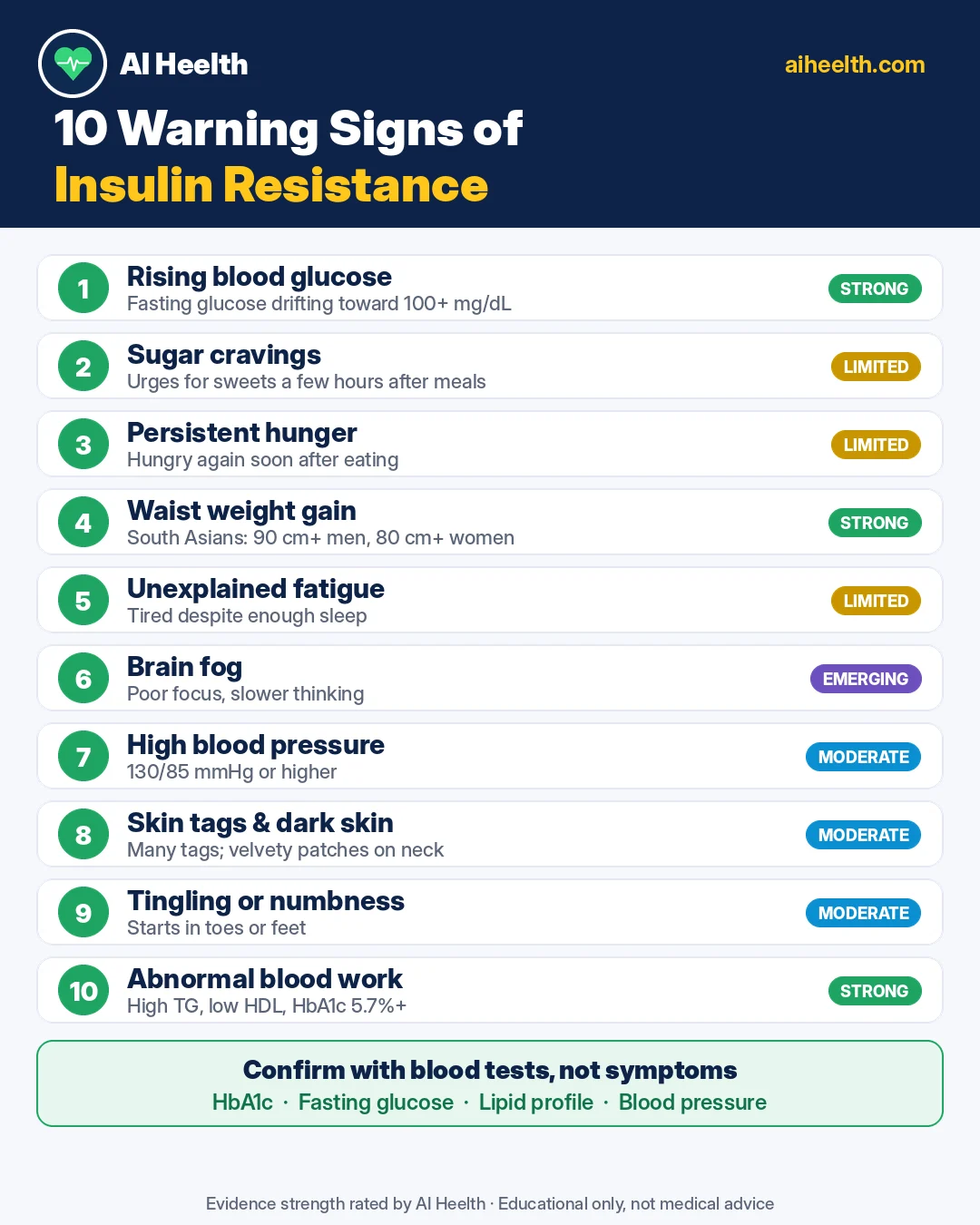
What does each warning sign mean?
01 Rising blood glucose Strong link
- What you notice
- A routine test shows fasting glucose drifting upward over the years, even if each result is labelled “normal”.
- Why it happens
- When cells respond poorly to insulin, more glucose stays in the blood. At first extra insulin hides this; a steady upward trend can mean the pancreas is starting to fall behind.
- Official ranges
- Fasting glucose below 100 mg/dL is normal, 100–125 mg/dL is prediabetes and 126 mg/dL or higher (confirmed on repeat testing) is diabetes.[1]
- Next step
- Keep copies of your results and compare them over time. If fasting glucose is 100 or more, ask for an HbA1c test.
02 Sugar cravings Limited link
- What you notice
- A strong pull toward sweets or refined carbs, often mid-afternoon or late evening.
- Why it may happen
- Large swings in blood sugar may play a part. In a study of over 1,000 people wearing glucose monitors, a bigger dip in glucose 2–3 hours after a meal predicted more hunger and more eating later.[15] That study was in healthy adults, so it shows a plausible mechanism rather than proof that cravings mean insulin resistance.
- Other causes
- Stress, poor sleep, habit, skipped meals and very low-calorie diets all drive cravings.
- Next step
- Pair carbs with protein and fibre. If cravings come with other signs on this list, get tested.
03 Persistent hunger Limited link
- What you notice
- Feeling hungry again soon after a full meal, or eating more often without feeling satisfied.
- Why it may happen
- The same post-meal glucose dips linked to cravings are also linked to shorter gaps between meals and higher food intake over the day.[15] Meals heavy in refined carbs and low in protein and fibre tend to make this worse.
- Other causes
- Thirst, dehydration, an overactive thyroid, some medicines and, in diabetes, very high blood sugar.
- Next step
- Build meals around vegetables, protein and whole grains (see our guide to good carbs vs bad carbs). Unusual hunger with weight loss needs prompt medical review.
04 Weight gain around the waist Strong link
- What you notice
- Your waist grows even if your overall weight changes little, or weight is hard to shift around the middle.
- Why it happens
- Overweight, obesity and a large waist are leading risk factors for insulin resistance.[3] Fat stored deep in the abdomen is closely tied to metabolic problems, and high insulin levels favour fat storage, so each can feed the other.
- Waist targets
- For South Asian adults, international criteria flag central obesity at 90 cm or more for men and 80 cm or more for women (94 cm for European men).[17]
- Next step
- Measure your waist at the level of your navel, breathing out normally. Check your BMI with our Asian BMI chart; for people of Asian heritage, risk starts rising from a BMI of 23.[20]
05 Unexplained fatigue Limited link
- What you notice
- Feeling drained most days, needing naps, or a heavy slump after meals.
- Why it may happen
- When cells use glucose less efficiently, energy can feel uneven, and blood sugar swings after meals may add to the slump. Fatigue is also frequently reported by people with prediabetes and diabetes.
- Other causes
- Fatigue is one of the least specific symptoms. Anaemia, low thyroid, poor sleep or sleep apnoea, depression, vitamin B12 or D deficiency and many medicines are common culprits.
- Next step
- Ask your doctor for a basic check (blood count, thyroid, glucose, HbA1c), especially if tiredness is new or getting worse.
06 Brain fog Emerging research
- What you notice
- Trouble concentrating, slower thinking, or misplacing things more often.
- What research shows
- The brain responds to insulin too, and research reviews link impaired brain insulin signalling with memory problems and Alzheimer’s disease.[13] Some researchers call Alzheimer’s “type 3 diabetes”, but this is a research term, not an official diagnosis, and scientists are still debating cause and effect.[14]
- Other causes
- Poor sleep, stress, low mood, dehydration, thyroid problems, menopause and some medicines.
- Next step
- See a doctor if memory or thinking is clearly changing, especially if family or friends notice it too.
07 High blood pressure Moderate link
- What you notice
- Usually nothing. High blood pressure is found by measuring it.
- Why they’re linked
- Insulin resistance and high blood pressure often occur together. Insulin can make the kidneys hold on to more sodium and water, and it may increase nervous-system activity, both of which can raise pressure.[8] Researchers still debate how much high insulin causes hypertension directly versus excess body fat driving both.[9]
- Threshold to know
- 130/85 mmHg or higher counts as raised in metabolic syndrome criteria.[17]
- Next step
- Check your blood pressure regularly. If it is raised, ask for glucose and cholesterol tests too. Never stop or change blood-pressure medicine without your doctor. Read our blood pressure myths vs facts.
08 Skin tags and dark velvety skin Moderate link
- What you notice
- Several small, soft, skin-coloured growths on the neck, armpits or groin. Some people also get acanthosis nigricans: darker, thick, velvety skin in body folds such as the back of the neck.
- Why it happens
- High insulin levels can stimulate skin cells to grow. Dermatology reviews describe skin tags and acanthosis nigricans as visible clues to insulin resistance,[12] and clinical references suggest checking blood sugar in people with many skin tags.[19]
- Good to know
- Skin tags themselves are harmless and very common. One or two mean little; many, or new dark velvety patches, are worth mentioning to a doctor.
- Next step
- Ask for fasting glucose and HbA1c tests. Have any growth that bleeds, changes colour or grows quickly checked.
09 Tingling, burning or numbness (neuropathy) Moderate link
- What you notice
- Pins and needles, burning pain or numbness that usually starts in the toes or feet and may later affect the hands.
- What research shows
- Nerve damage is not limited to diabetes. Reviews estimate that 11–25% of people with prediabetes have peripheral neuropathy, mostly affecting small sensory nerves.[11] Estimates vary widely because studies test nerves in different ways.[10]
- Other causes
- Vitamin B12 deficiency, alcohol, thyroid disease, kidney disease and some medicines.
- Next step
- See a doctor about new tingling or numbness. Check your feet daily for cuts or sores you might not feel.
10 Abnormal blood work Strong link
- What you notice
- A lab report with high triglycerides, low HDL (“good”) cholesterol or an HbA1c of 5.7% or more.
- Why it matters
- Insulin resistance is closely linked to unhealthy triglyceride and cholesterol levels, fatty liver disease and high blood pressure.[3] These changes can appear before blood sugar becomes clearly abnormal.
- The TG/HDL ratio
- Triglycerides divided by HDL is a cheap, widely studied clue to insulin resistance. A 2024 review of 32 studies found it predicts insulin resistance better in men than in women, with average cutoffs of about 2.8 for men and 2.5 for women (mg/dL units), but there is no official threshold.[16] It performs poorly in people of African ancestry.[18] Our lab checker calculates it for you.
- Next step
- Ask your doctor to look at your glucose, HbA1c, lipids, liver tests and blood pressure together rather than one at a time.
Free insulin resistance and prediabetes risk score
Most “insulin resistance quizzes” online simply count symptoms. This one is different: Part A uses the validated scoring method behind the CDC/ADA Prediabetes Risk Test (Bang et al., 2009), including the lower BMI cutoff for people of Asian heritage.[20] Part B adds the extra clues covered in this article. It takes about a minute, works in kg/cm or lb/ft, and stays private: nothing is stored or sent anywhere.
Do I need a blood sugar test?
This tool estimates risk; it cannot diagnose insulin resistance, prediabetes or diabetes. The original algorithm was validated in US adults without the gestational-diabetes question, which CDC and ADA later added.[20]
Which blood tests check for insulin resistance?
There is no routine “insulin resistance test” in everyday practice.[3] Instead, doctors combine standard blood sugar tests, which diagnose prediabetes and diabetes, with your lipids, blood pressure and waist size. Having any 3 of the 5 metabolic syndrome criteria (large waist, high triglycerides, low HDL, raised blood pressure, raised fasting glucose) is a strong practical marker of insulin resistance.[17]
| Test | Normal | Prediabetes | Diabetes* | Source |
|---|---|---|---|---|
| HbA1c (3-month average) | Below 5.7% | 5.7–6.4% | 6.5% or higher | ADA 2026 |
| Fasting plasma glucose | Below 100 mg/dL (5.6 mmol/L) | 100–125 mg/dL (5.6–6.9 mmol/L) | 126 mg/dL+ (7.0 mmol/L+) | ADA 2026 |
| 2-hour oral glucose tolerance test | Below 140 mg/dL (7.8 mmol/L) | 140–199 mg/dL (7.8–11.0 mmol/L) | 200 mg/dL+ (11.1 mmol/L+) | ADA 2026 |
| HbA1c in mmol/mol (UK, Gulf and many Pakistani labs) | Below 39 | 39–47 | 48 or higher | ADA 2026 (converted) |
*Without obvious high blood sugar symptoms, a diabetes diagnosis needs two abnormal results, either from the same sample or on separate days.[1] The WHO and IDF use a slightly higher starting point for impaired fasting glucose, 110 mg/dL (6.1 mmol/L), so a result of 100–109 may be labelled “normal” on some lab reports.[21]
| Test | What raises concern | Notes | Source |
|---|---|---|---|
| Triglycerides (fasting) | 150 mg/dL (1.7 mmol/L) or higher | Part of metabolic syndrome criteria | Harmonised MetS[17] |
| Blood pressure | 130/85 mmHg or higher | Or on blood-pressure medicine | Harmonised MetS[17] |
| HDL cholesterol | Below 40 mg/dL (men) or 50 mg/dL (women) | Low “good” cholesterol; part of metabolic syndrome criteria | Harmonised MetS[17] |
| TG/HDL ratio | No universal cutoff | Useful clue; average cutoffs about 2.8 (men) and 2.5 (women); poor in African ancestry | Review[16] |
| Fasting insulin / HOMA-IR | No standard reference range | Used mainly in research; lab methods vary | NIDDK[3] |
| Liver tests (ALT) | Raised levels | Can suggest fatty liver (MASLD), which is linked to insulin resistance | NIDDK[3] |
Lab result checker: are my numbers in range?
Have a recent lab report? Enter whatever you have and leave the rest blank. The checker compares each number with ADA 2026 glucose ranges and the international metabolic syndrome criteria, and works out your triglyceride/HDL ratio. It accepts mg/dL or mmol/L, and HbA1c as % or mmol/mol, so you can type numbers straight from a Pakistani, UK, Gulf or US lab report.
Metabolic health lab checker
Uses ADA 2026 ranges for HbA1c and fasting glucose,[1] and the 2009 harmonised metabolic syndrome criteria with ethnicity-specific waist cutoffs.[17] Educational only; one result never confirms a diagnosis, and lab reference ranges vary slightly.
Who is most at risk of insulin resistance?
According to the NIDDK, the main risk factors are:[3]
- Overweight, obesity or a large waist
- Physical inactivity
- Age 35 or older
- A family history of diabetes
- South Asian, Black, Hispanic, Native American or Pacific Islander heritage
- Smoking or second-hand smoke
- Diabetes during pregnancy, or having a baby weighing 9 lb (4 kg) or more
- Conditions such as PCOS and sleep apnoea, and long-term use of some medicines such as steroids
The ADA recommends screening all adults from age 35, and earlier for adults who are overweight (BMI 23 or more if Asian) and have other risk factors.[1][2]
Can insulin resistance be reversed?
For many people, insulin sensitivity can improve substantially, and the progression to type 2 diabetes can be delayed or prevented. The strongest evidence comes from the US Diabetes Prevention Program. Adults at high risk who aimed to lose at least 7% of their body weight and do 150 minutes of activity a week cut their chance of developing type 2 diabetes by 58% compared with placebo.[7] The benefits lasted for at least 15 years in follow-up.[3]
| Step | Practical target | Why it helps |
|---|---|---|
| Move more | 150 minutes a week of brisk walking or similar, plus strength work twice a week | Active muscles take up glucose with less insulin |
| Lose a little weight (if overweight) | 5–7% of body weight, e.g. 3.5–5 kg for someone weighing 70 kg | Reduced the chance of type 2 diabetes in the DPP[3] |
| Upgrade carbs | Swap white rice, white bread and sugary drinks for whole grains, lentils, vegetables and fruit | Fibre slows glucose absorption and reduces spikes |
| Add protein to meals | Eggs, dal, fish, chicken, yoghurt or beans at each meal | Helps fullness and steadier blood sugar |
| Sleep well | 7–9 hours; get checked for sleep apnoea if you snore loudly | Sleep apnoea is a known risk factor[3] |
| Stop smoking | Ask about quit support | Smoking is a known risk factor[3] |
Some people also need medicine. Metformin, for example, reduced new cases of type 2 diabetes by 31% in the same trial, less than lifestyle change did.[7] Whether medicine is right for you is a decision for your doctor.
When should you see a doctor?
Book a routine appointment if you:
- score 5 or more on the risk score above, or tick 2 or more extra clues
- meet 3 or more metabolic syndrome criteria in the lab checker
- are 35 or older and have never had your blood sugar checked
- have many new skin tags, dark velvety skin, or new tingling or numbness in your feet
- have had a “borderline” glucose or HbA1c result before
Frequently asked questions
What is usually the first sign of insulin resistance?
Often there is no noticeable first sign. The earliest clues are usually things you can measure: a growing waist, fasting glucose or HbA1c creeping upward, high triglycerides, low HDL cholesterol or raised blood pressure. That is why testing matters more than waiting for symptoms.
Can you have insulin resistance with normal blood sugar?
Yes. In the early stages the pancreas releases extra insulin to keep blood sugar normal, so glucose and HbA1c results can look fine for years. Waist size, triglycerides, HDL cholesterol and blood pressure often give earlier clues.
Can you have insulin resistance if you are not overweight?
Yes. Fat stored around the abdomen and liver matters more than total weight, and inactivity, family history, PCOS and some medicines also play a part. South Asians in particular tend to develop insulin resistance at a lower body weight, which is why lower BMI and waist cutoffs are used for them.
How do doctors test for insulin resistance?
In everyday practice they don’t measure it directly. They check fasting glucose, HbA1c or a glucose tolerance test, plus lipids, blood pressure and waist size. Specialist measures such as the insulin clamp test are used mainly in research.
Is there a normal range for fasting insulin or HOMA-IR?
There is no universally agreed reference range. Laboratories use different insulin assays, and studies use different HOMA-IR cutoffs for different populations. If your doctor orders these tests, ask them to interpret the result alongside your other numbers.
What HbA1c level means insulin resistance?
No HbA1c level diagnoses insulin resistance, because HbA1c measures average blood sugar, not insulin action. An HbA1c of 5.7 to 6.4 percent is prediabetes and 6.5 percent or higher suggests diabetes (ADA 2026). Insulin resistance can be present while HbA1c is still normal.
Are skin tags a sign of diabetes?
Not on their own. Skin tags are common and harmless. Having many of them, especially with dark velvety skin on the neck or armpits (acanthosis nigricans), is linked to insulin resistance and is a good reason to have your blood sugar checked.
Is insulin resistance the same as prediabetes?
No. Insulin resistance describes how your cells respond to insulin and often comes first. Prediabetes is a diagnosis made when blood sugar is above normal but below the diabetes range: HbA1c 5.7 to 6.4 percent or fasting glucose 100 to 125 mg/dL.
Can insulin resistance be reversed?
For many people, yes, at least partly. Regular activity, modest weight loss if overweight, better-quality carbohydrates, enough sleep and not smoking all improve insulin sensitivity. In the Diabetes Prevention Program, lifestyle change lowered the risk of type 2 diabetes by 58 percent.
Why are South Asians at higher risk of insulin resistance?
South Asians tend to store more fat around the abdomen and develop insulin resistance at a lower body weight than Europeans. That is why lower waist cutoffs are used for South Asians: 90 cm for men and 80 cm for women. Pakistan has the highest age-standardised adult diabetes prevalence in the world, at 31.4 percent (IDF Diabetes Atlas, 2025).
Should I cut out carbs completely?
No. The quality and amount of carbohydrate matter more than avoiding it completely. Choose whole grains, lentils, vegetables and whole fruit over refined grains and sugary drinks, and pair carbs with protein and fibre.
How often should I get my blood sugar checked?
The ADA recommends screening all adults from age 35, repeated at least every 3 years if results are normal, earlier and more often if you are overweight with other risk factors, and at least yearly once prediabetes is found.
Take the next step
Know your numbers. Run the risk score, check your latest lab report, then use our free tools to plan healthier days.
Get my risk score Check your BMI Lower your HbA1cSources
- American Diabetes Association Professional Practice Committee. 2. Diagnosis and Classification of Diabetes: Standards of Care in Diabetes—2026. Diabetes Care 2026;49(Suppl 1):S27–S49. doi:10.2337/dc26-S002
- American Diabetes Association Professional Practice Committee. 3. Prevention or Delay of Diabetes and Associated Comorbidities: Standards of Care in Diabetes—2026. Diabetes Care 2026;49(Suppl 1):S50–S60. doi:10.2337/dc26-S003
- National Institute of Diabetes and Digestive and Kidney Diseases (NIDDK). Insulin Resistance & Prediabetes.
- Centers for Disease Control and Prevention. About Prediabetes and Type 2 Diabetes.
- International Diabetes Federation. IDF Diabetes Atlas, 11th edition (2025): Pakistan country report.
- Rooney MR, et al. Global and Regional Prediabetes Prevalence: Updates for 2024 and Projections for 2050. Diabetes Care 2025;48(11):e142–e144. doi:10.2337/dc25-1640
- Diabetes Prevention Program Research Group (Knowler WC, et al.). Reduction in the incidence of type 2 diabetes with lifestyle intervention or metformin. N Engl J Med 2002;346:393–403.
- Brosolo G, et al. Insulin Resistance and High Blood Pressure: Mechanistic Insight on the Role of the Kidney. Biomedicines 2022;10:2374. doi:10.3390/biomedicines10102374
- da Silva AA, et al. Role of Hyperinsulinemia and Insulin Resistance in Hypertension: Metabolic Syndrome Revisited. Can J Cardiol 2020;36:671–682.
- Kirthi V, et al. Prevalence of peripheral neuropathy in pre-diabetes: a systematic review. BMJ Open Diabetes Res Care 2021;9:e002040.
- Papanas N, Vinik AI, Ziegler D. Neuropathy in prediabetes: does the clock start ticking early? Nat Rev Endocrinol 2011;7:682–690.
- González-Saldivar G, et al. Skin Manifestations of Insulin Resistance: From a Biochemical Stance to a Clinical Diagnosis and Management. Dermatol Ther (Heidelb) 2017;7:37–51. doi:10.1007/s13555-016-0160-3
- Kellar D, Craft S. Brain insulin resistance in Alzheimer’s disease and related disorders: mechanisms and therapeutic approaches. Lancet Neurol 2020;19:758–766. doi:10.1016/S1474-4422(20)30231-3
- de la Monte SM, Wands JR. Alzheimer’s disease is type 3 diabetes—evidence reviewed. J Diabetes Sci Technol 2008;2:1101–1113.
- Wyatt P, et al. Postprandial glycaemic dips predict appetite and energy intake in healthy individuals. Nat Metab 2021;3:523–529.
- Baneu P, et al. The Triglyceride/HDL Ratio as a Surrogate Biomarker for Insulin Resistance. Biomedicines 2024;12(7):1493. doi:10.3390/biomedicines12071493
- Alberti KGMM, et al. Harmonizing the Metabolic Syndrome: a joint interim statement of the IDF, NHLBI, AHA, WHF, IAS and IASO. Circulation 2009;120:1640–1645.
- Sumner AE, et al. Fasting triglyceride and the triglyceride-HDL cholesterol ratio are not markers of insulin resistance in African Americans. Arch Intern Med 2005;165:1395–1400.
- MSD Manual Professional Version. Skin Tags.
- Bang H, et al. Development and validation of a patient self-assessment score for diabetes risk. Ann Intern Med 2009;151:775–783. Scoring as used by CDC: How Your Prediabetes Risk Test Is Scored.
- World Health Organization & International Diabetes Federation. Definition and diagnosis of diabetes mellitus and intermediate hyperglycaemia. 2006.
How we create and review content: AI Heelth articles are researched from current clinical guidelines (ADA, WHO, IDF, NIDDK, CDC) and peer-reviewed studies, written in plain language, and checked line by line against those sources. Every reference on this page was verified against PubMed or the publisher before publishing. We rate the strength of evidence for each sign so you can see which claims are well established, and we review this page at least every six months or sooner when guidelines change. Spot an error? Tell us.
Medical disclaimer: The content and tools on AI Heelth are for general education only and are not a substitute for professional medical advice, diagnosis or treatment. The risk score and lab checker cannot diagnose any condition. Always discuss symptoms and test results with your doctor, and never start, stop or change prescribed medicine without medical advice. In an emergency, call your local emergency number (1122 in Pakistan).
Last reviewed: 20 November 2026 · Next review: May 2027 · Back to top