
Quick answer
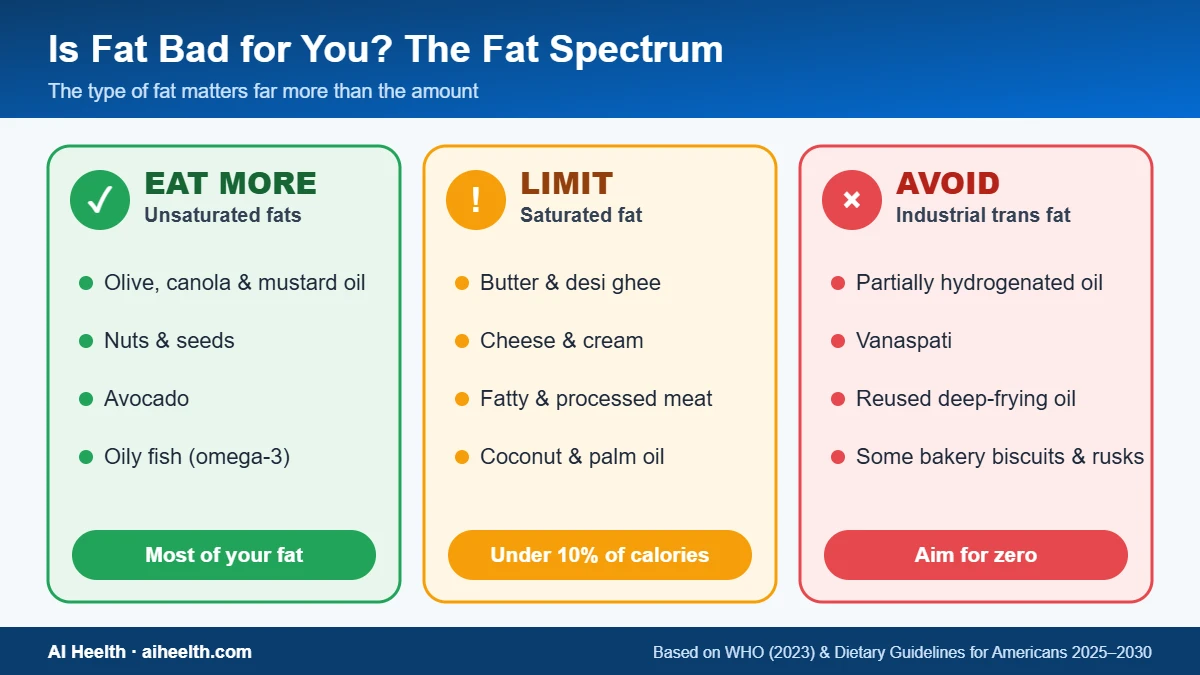
Is fat bad for you? No — fat is not bad for you. Your body needs it, and the type of fat matters far more than the amount. Build your meals around unsaturated fats (olive, canola and mustard oil, nuts, seeds, avocado and oily fish), keep saturated fat under 10% of your daily calories (about 22 g on a 2,000-calorie day), and avoid industrial trans fat from partially hydrogenated oils and vanaspati completely. Most adults do well with fat supplying 20–30% of calories. Use the free calculator below to get your personal numbers.
Key facts at a glance
- Fat is an essential nutrient: it builds every cell membrane, carries vitamins A, D, E and K, and helps make hormones.
- WHO (2023) advises adults to keep total fat at 30% of calories or less; US guidance allows 20–35%.
- Saturated fat should stay under 10% of calories (WHO and US Dietary Guidelines 2025–2030); about 6% if you need to lower LDL cholesterol (American Heart Association).
- Trans fat should stay under 1% of calories — and industrial trans fat is best avoided completely.
- Industrial trans fat is linked to more than 278,000 heart-disease deaths a year worldwide (WHO, 2025).
- Swapping saturated fat for unsaturated fat — not for sugar or white flour — is the change most consistently linked to a healthier heart.
Table of Contents
Free Fat Intake Calculator: How Much Fat Should You Eat per Day?
Enter a few details to see your personal daily limits for total fat, saturated fat and trans fat, plus your omega-3 targets. The calculator follows the WHO 2023 fat guideline, the Dietary Guidelines for Americans 2025–2030 and American Heart Association advice for people managing cholesterol. It also converts your saturated-fat limit into everyday foods such as butter, desi ghee and cheese, and includes a food-label checker you can use in the shop.
Daily Fat Intake Calculator
Your personal limits for total fat, saturated fat and trans fat, plus omega-3 targets, based on WHO (2023), the Dietary Guidelines for Americans 2025–2030 and American Heart Association advice.
Food label checker — how much of your saturated fat limit does one snack use?
Educational tool for adults 18+. Calorie needs are estimated with the Mifflin–St Jeor equation and are approximate. Not suitable during pregnancy, for children, or if your doctor or dietitian has given you a specific fat or calorie plan.
Is Fat Bad for You?
No. Fat is one of the three macronutrients your body cannot live without, alongside protein and carbohydrate. It is the most concentrated energy source in food (9 calories per gram, against 4 for protein and carbs), and it does several jobs nothing else can do:
- Builds cells. Every cell in your body is wrapped in a membrane made largely of fat.
- Feeds the brain and nerves. The brain is roughly 60% fat by dry weight, and the omega-3 fat DHA is a major structural part of it and of the retina.
- Unlocks vitamins. Vitamins A, D, E and K only dissolve in fat — eat a salad with no fat at all and you absorb far fewer of them.
- Makes hormones. Fats and cholesterol are raw materials for hormones and signalling molecules.
- Keeps you full. Fat slows digestion, which helps meals feel satisfying.
So the real answer to “is fat bad for you?” depends on a better question: “which fats, and how much?” That is what the rest of this guide answers.
Why Did the Low-Fat Era Backfire?
From the 1980s onward, “eat less fat” became the headline health message. Food companies responded with thousands of fat-free and low-fat products — and to keep them tasting good, they often added sugar and refined starch. Rates of obesity and type 2 diabetes kept climbing.
So is fat bad for you after all? Not in itself. The lesson, now reflected in WHO and US guidance, is that what you replace fat with decides the outcome. A large Cochrane review (2020) found that cutting saturated fat for at least two years was linked to about a 17% lower risk of combined cardiovascular events — with the clearest benefit when it was replaced by unsaturated fat rather than refined carbohydrate. Swapping butter for sugar does your heart no favours; swapping butter for olive oil may.
How Much Fat Should You Eat per Day?
Major health bodies agree on the shape of a healthy fat intake, even if their exact numbers differ slightly. Here is what each currently recommends for adults:
| Source (latest edition) | Total fat | Saturated fat | Trans fat |
|---|---|---|---|
| World Health Organization guideline (2023) | 30% of calories or less | Under 10% of calories | Under 1% of calories |
| Dietary Guidelines for Americans 2025–2030 | 20–35% of calories (Acceptable Macronutrient Distribution Range) | Under 10% of calories | As low as possible |
| American Heart Association | Focus on fat quality rather than a strict total | About 6% of calories if you need to lower LDL cholesterol | Avoid |
| Pakistan Standards (PSQCA, 2025) | — | — | Industrial trans fat capped below 2% of total fat in foods |
Turned into grams, those percentages look like this:
| Daily calories | Total fat (20–30%) | Saturated fat — under 10% | Saturated fat — about 6% (high LDL) | Trans fat — under 1% |
|---|---|---|---|---|
| 1,600 kcal | 36–53 g | under 18 g | about 11 g | under 1.8 g |
| 1,800 kcal | 40–60 g | under 20 g | about 12 g | under 2 g |
| 2,000 kcal | 44–67 g | under 22 g | about 13 g | under 2.2 g |
| 2,200 kcal | 49–73 g | under 24 g | about 15 g | under 2.4 g |
| 2,500 kcal | 56–83 g | under 28 g | about 17 g | under 2.8 g |
Over 50? Calorie needs usually fall with age while vitamin and protein needs do not. That makes fat quality even more important: your smaller fat “budget” should come mostly from foods that also bring fibre, vitamins and omega-3, such as nuts, seeds, oily fish and olive or canola oil.
Good Fats vs. Bad Fats: What Is the Difference?
Dietary fats are grouped by their chemical structure, which changes how they behave in your blood vessels. In short: unsaturated fats are the “good fats”, saturated fat is the “limit it” fat, and industrial trans fat is the “bad fat”.
| Type of fat | Main food sources | Effect on cholesterol | Verdict |
|---|---|---|---|
| Monounsaturated (MUFA) | Olive oil, canola and mustard oil, avocado, almonds, peanuts, cashews | May lower LDL (“bad”) cholesterol when it replaces saturated fat | ✅ Eat regularly |
| Polyunsaturated omega-6 | Sunflower, soybean, corn and safflower oil; walnuts; sunflower and sesame seeds | Lowers LDL cholesterol when it replaces saturated fat | ✅ Eat regularly |
| Polyunsaturated omega-3 | Salmon, sardines, mackerel, trout (EPA, DHA); flaxseed, chia, walnuts (ALA) | Lowers triglycerides; supports heart rhythm and brain | ✅ Make sure you get enough |
| Saturated | Butter, desi ghee, cream, cheese, fatty and processed meat, coconut and palm oil, many baked goods | Raises LDL cholesterol in most people | ⚠️ Limit to under 10% of calories |
| Industrial trans | Partially hydrogenated oils, vanaspati, some fried street and fast foods, older-style biscuits, rusks, puff pastry and margarines | Raises LDL and lowers HDL (“good”) cholesterol | ❌ Avoid completely |
| Natural (ruminant) trans | Small amounts in milk, butter and beef or mutton fat | Intake is normally tiny | Counted within the saturated-fat foods you already limit |
Definition — unsaturated fat: fat whose molecules contain one (mono-) or more (poly-) double bonds, which keeps it liquid at room temperature. Found mainly in plant oils, nuts, seeds, avocado and fish.
What Are the Healthiest Fats to Eat?
The fats most consistently linked to better heart and metabolic health come packaged in whole, minimally processed foods. Good everyday choices include:
- Extra-virgin olive oil — rich in monounsaturated fat and protective plant compounds (polyphenols); a cornerstone of the Mediterranean diet.
- Canola (rapeseed) and mustard oil — low in saturated fat and among the few cooking oils with useful plant omega-3 (ALA); well suited to South Asian cooking.
- Nuts and seeds — walnuts, almonds, pistachios, peanuts, flax, chia, pumpkin and sunflower seeds bring fibre, protein and minerals along with healthy fat. A small handful (about 30 g) a day is a sensible portion.
- Avocado — monounsaturated fat plus fibre and potassium.
- Oily fish — the best source of the long-chain omega-3s EPA and DHA.
- Soybean, sunflower and corn oils — high in polyunsaturated fat, which lowers LDL cholesterol when it replaces butter or ghee.
How Much Omega-3 Do You Need?
Omega-3 fats are “essential” — your body cannot make them in useful amounts, so they have to come from food. There are two main kinds:
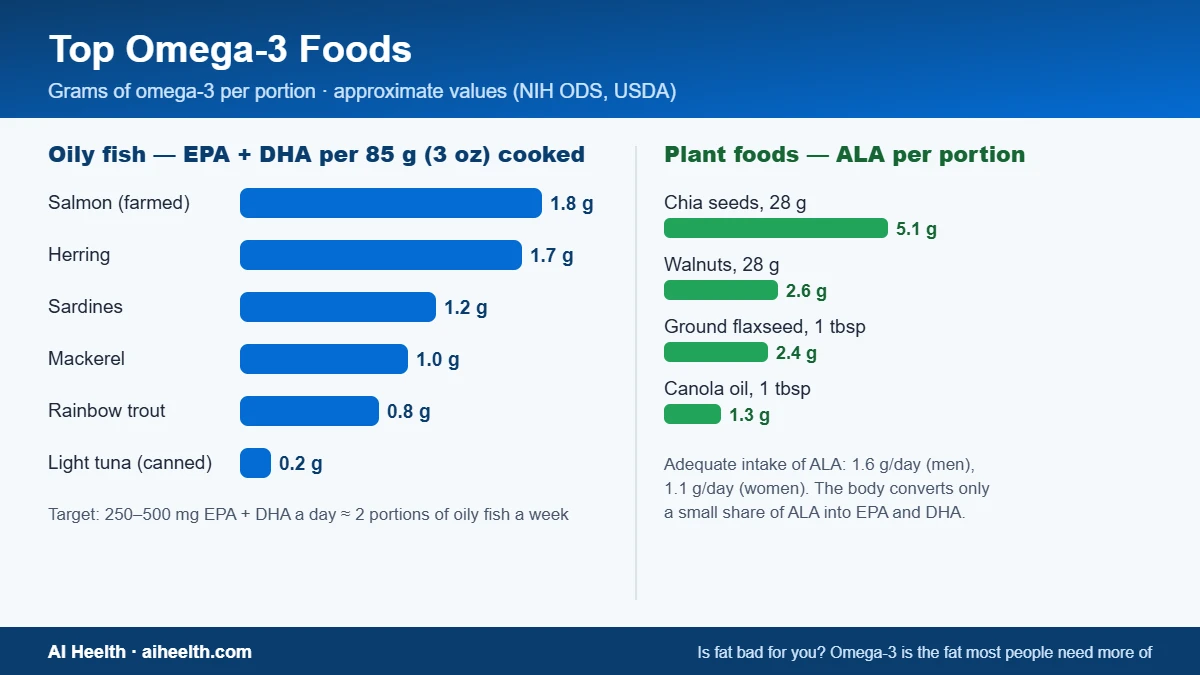
- EPA and DHA, found in oily fish and seafood. Many health authorities, including the European Food Safety Authority, set a target of about 250–500 mg a day, which the American Heart Association translates into two servings of fish a week, preferably oily fish.
- ALA, found in flaxseed, chia, walnuts, canola oil and soybeans. The US adequate intake is 1.6 g a day for men and 1.1 g for women. The body converts only a small share of ALA into EPA and DHA, so vegetarians may wish to discuss an algae-based omega-3 with their doctor.
| Food and portion | Omega-3 per portion | Type |
|---|---|---|
| Salmon, Atlantic farmed, cooked, 85 g (3 oz) | ≈ 1.8 g | EPA + DHA |
| Herring, cooked, 85 g | ≈ 1.7 g | EPA + DHA |
| Sardines, canned, 85 g | ≈ 1.2 g | EPA + DHA |
| Mackerel, Atlantic, cooked, 85 g | ≈ 1.0 g | EPA + DHA |
| Rainbow trout, cooked, 85 g | ≈ 0.8 g | EPA + DHA |
| Light tuna, canned, 85 g | ≈ 0.2 g | EPA + DHA |
| Chia seeds, 28 g (about 2 tbsp) | ≈ 5.1 g | ALA |
| Walnuts, 28 g (about 7 halves) | ≈ 2.6 g | ALA |
| Ground flaxseed, 1 tbsp | ≈ 2.4 g | ALA |
| Canola oil, 1 tbsp | ≈ 1.3 g | ALA |
Thinking about fish oil capsules? Food first is the safest approach. High-dose omega-3 supplements (around 1 g a day or more) have been linked to a higher risk of atrial fibrillation in some trials and can add to the effect of blood thinners. Talk to your doctor before starting one, especially if you take anticoagulant or antiplatelet medicines.
Is Saturated Fat Bad for You?
Saturated fat is not a poison, but the evidence still supports keeping it modest. In most people it raises LDL cholesterol, a key driver of artery disease. That is why the WHO (2023) and the Dietary Guidelines for Americans 2025–2030 both keep the long-standing limit of under 10% of calories, and the American Heart Association suggests about 6% for people who need to lower their LDL.
The nuance is in the food it comes in. Research suggests that saturated fat in fermented dairy such as yogurt and cheese seems less harmful than the same amount in processed meat, pastries or deep-fried snacks. The newest US guidelines also make room for full-fat dairy and for cooking with butter or beef tallow — but they kept the 10% cap, and a few servings of these foods can use most of it, as the table below shows.
| Food and portion | Saturated fat (approx.) | Share of a 22 g daily limit* |
|---|---|---|
| Coconut oil, 1 tbsp | 12 g | 55% |
| Desi ghee, 1 tbsp | 8 g | 36% |
| Butter, 1 tbsp | 7 g | 32% |
| Palm oil, 1 tbsp | 7 g | 32% |
| Beef mince 80% lean, cooked, 85 g | 6 g | 27% |
| Cheddar cheese, 30 g slice | 5.5 g | 25% |
| Whole milk, 1 cup (240 ml) | 4.5 g | 20% |
| Avocado, half | 2 g | 9% |
| Olive oil, 1 tbsp | 2 g | 9% |
| Egg, 1 large | 1.6 g | 7% |
| Almonds, 28 g | 1.1 g | 5% |
Definition — saturated fat: fat whose molecules have no double bonds, which usually makes it solid at room temperature. Found mainly in animal foods and in coconut and palm oil.
What Is the One Fat You Should Avoid?
Industrial trans fat — the one case where the answer to “is fat bad for you?” is clearly yes. It is created when liquid vegetable oil is partially hydrogenated to make it solid and shelf-stable. It offers no health benefit and does double damage: it raises LDL cholesterol and lowers protective HDL cholesterol. The WHO links it to more than 278,000 deaths from coronary heart disease every year.
Governments are acting. As of 2025, nearly 60 countries — covering about 46% of the world’s population — have WHO best-practice rules in force, meaning either a ban on partially hydrogenated oils or a limit of 2 g of trans fat per 100 g of total fat. The United States removed partially hydrogenated oils from its food supply over 2018–2020, and Pakistan adopted a national standard in 2025 that caps industrial trans fat below 2% of total fat. Enforcement is still catching up in many markets, so it pays to check labels.
How to spot hidden trans fat
- Read the ingredients for “partially hydrogenated oil”, “vanaspati” or “hydrogenated vegetable fat”.
- Do not rely on “0 g trans fat” alone: in some countries a product can show zero if a serving contains less than 0.5 g.
- Be cautious with deep-fried street food, bakery biscuits, rusks, nimko, puff pastry and some non-dairy creamers, especially from unbranded sources.
- Avoid reheating frying oil again and again. Repeated high-heat use breaks oil down into oxidised compounds and can form small amounts of trans fat.
Definition — trans fat: an unsaturated fat with a “trans” double bond. Industrial trans fat comes from partial hydrogenation of vegetable oils and is linked to heart disease; WHO recommends eliminating it from the food supply.
Are Seed Oils Bad for You?
Seed oils such as soybean, sunflower, corn and canola oil are popular targets on social media, but human research does not support the claim that they are toxic. In controlled trials and large long-term studies, replacing saturated fat with these polyunsaturated oils is linked to lower LDL cholesterol and lower rates of heart disease. Omega-6 fats also have not been shown to raise inflammation markers in healthy people.
The real problem is how these oils are often eaten: in deep-fried and ultra-processed foods that are also high in salt, refined starch and calories. Cooking at home with a moderate amount of canola, mustard, sunflower or olive oil is a very different thing from a daily packet of fried snacks.
Is Fat Bad for You After 50? What Changes With Age
Is fat bad for you as you get older? No — your fat “rules” stay the same, but a few things become more important with age:
- Cholesterol tends to rise. LDL cholesterol often increases in midlife, and in women it typically rises after menopause. Regular lipid checks help you and your doctor decide whether the 6% saturated-fat target suits you.
- Calorie needs drop. Your total fat budget shrinks, so every gram should work harder for you.
- Brain and eyes. DHA from oily fish is a structural fat in the brain and retina; regular fish intake is linked to healthier ageing, although supplements have shown mixed results.
- Vitamin absorption. Enough healthy fat with meals helps you absorb vitamin D and vitamin K, which support bones.
- Medicines. If you take statins, blood thinners or diabetes medicines, ask your doctor before making big diet changes or adding supplements.
How to Choose Healthy Fats Every Day
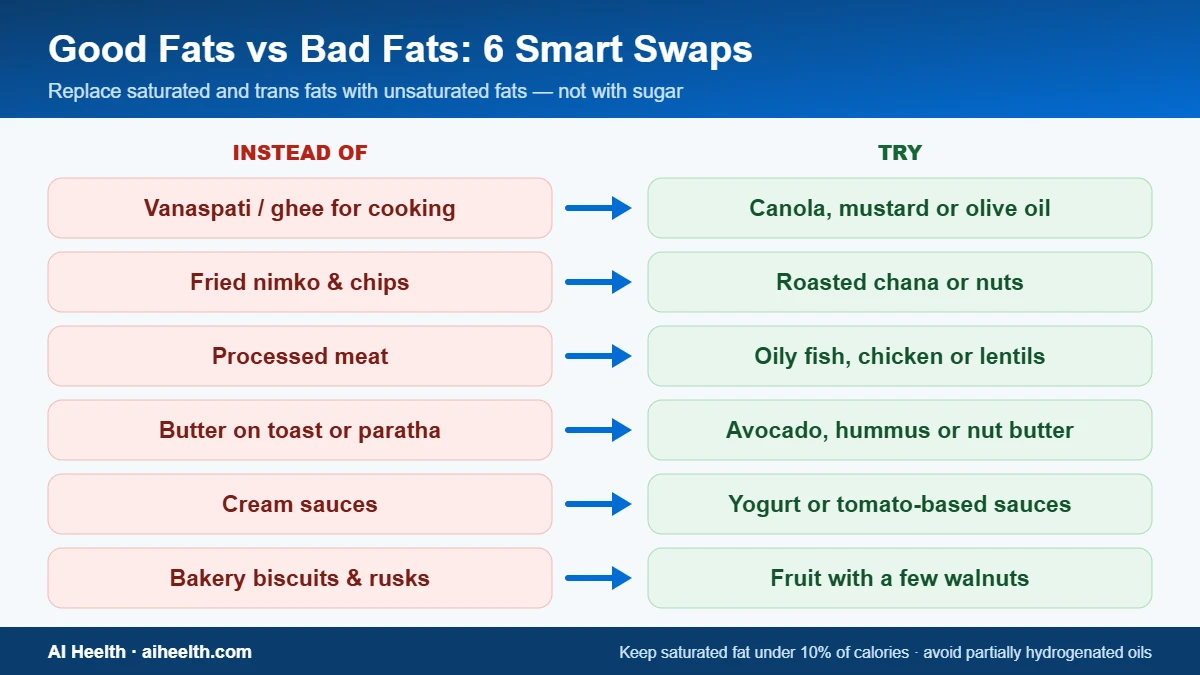
- Cook with liquid oils. Use olive, canola, mustard, sunflower or soybean oil instead of vanaspati, ghee or butter for everyday cooking — measure with a spoon rather than pouring.
- Eat oily fish twice a week. Salmon, sardines, mackerel, trout or herring. Canned sardines and mackerel are affordable options.
- Snack on nuts and seeds. A small handful of unsalted nuts instead of fried nimko, chips or biscuits.
- Keep butter, ghee, cream and cheese as flavourings, not the base of every meal.
- Choose fresh meat over processed, trim visible fat, and favour poultry, fish, lentils and beans.
- Read labels for saturated fat per serving and the words “partially hydrogenated”.
- Add a little fat to vegetables. A drizzle of olive oil or a few nuts on salads helps you absorb their fat-soluble vitamins.
| Instead of… | Try… | Why it helps |
|---|---|---|
| Vanaspati or ghee for daily cooking | Canola, mustard or olive oil | Swaps saturated and trans fat for unsaturated fat |
| Fried nimko, chips, samosas | Roasted chana or a handful of nuts | More fibre and protein, no reused frying oil |
| Processed meats (sausages, salami) | Oily fish, chicken, lentils or beans | Less saturated fat and salt; more omega-3 or fibre |
| Butter on toast or paratha | Avocado, hummus or nut butter | Unsaturated fat instead of saturated |
| Cream-based sauces | Yogurt-based sauces or tomato gravy | Big cut in saturated fat |
| Bakery biscuits and rusks | Fruit with a few walnuts | Avoids hidden trans fat and refined flour |
Key Takeaways
- Fat is essential — the type matters far more than the total.
- Aim for 20–30% of calories from fat, mostly from unsaturated sources.
- Keep saturated fat under 10% of calories (about 6% if your LDL is high).
- Avoid industrial trans fat: check labels for “partially hydrogenated” and “vanaspati”.
- Get omega-3 from two portions of oily fish a week, plus seeds and walnuts.
- Replace saturated fat with healthy fats, not with sugar or refined carbs.
- Choose whole foods over ultra-processed ones — the theme of our whole nutrition series.
Frequently Asked Questions
Is fat bad for you?
No. Fat is an essential nutrient that builds cells, carries vitamins A, D, E and K, and helps make hormones. What matters is the type: unsaturated fats are linked to better heart health, saturated fat should be limited to under 10% of calories, and industrial trans fat should be avoided.
How much fat should I eat per day?
Most adults do well with 20–30% of daily calories from fat. On a 2,000-calorie diet that is about 44–67 g of total fat, with less than 22 g of saturated fat. WHO advises 30% of calories or less; US guidance allows up to 35%.
What are good fats and bad fats?
Good fats are unsaturated fats from olive, canola and mustard oil, nuts, seeds, avocado and oily fish. The bad fat is industrial trans fat from partially hydrogenated oils and vanaspati. Saturated fat from butter, ghee, cheese and fatty meat sits in between and is best kept to under 10% of calories.
Is saturated fat really bad for you?
Saturated fat raises LDL cholesterol in most people, so WHO and the Dietary Guidelines for Americans 2025–2030 still advise under 10% of calories. The source matters: fermented dairy appears less harmful than processed meat or fried snacks. Replacing saturated fat with unsaturated fat is linked to lower heart risk.
Is desi ghee healthy?
Desi ghee is about 60% saturated fat, and one tablespoon has roughly 8 g of it, more than a third of a 2,000-calorie daily limit. Small amounts for flavour can fit a healthy diet, but liquid oils such as canola, mustard or olive oil are better for everyday cooking, especially if your cholesterol is high.
Are seed oils bad for you?
Current human evidence does not show that seed oils such as canola, sunflower or soybean oil are harmful. Replacing saturated fat with these oils is linked to lower LDL cholesterol and fewer heart problems. The concern is mainly deep-fried, ultra-processed foods cooked in them.
What foods are high in omega-3?
Oily fish such as salmon, herring, sardines, mackerel and trout are the best sources of EPA and DHA. Plant foods such as chia seeds, flaxseed, walnuts and canola oil provide ALA. Aim for two portions of oily fish a week.
How do I know if a food contains trans fat?
Check the ingredients list for partially hydrogenated oil, hydrogenated vegetable fat or vanaspati. A label showing 0 g trans fat can still contain small amounts in some countries, so the ingredients list is the more reliable check.
Should people over 50 eat less fat?
Not necessarily less, but smarter. Calorie needs fall with age, so the fat budget shrinks, while the need for omega-3 and fat-soluble vitamins stays high. Focus on unsaturated fats and keep saturated fat low, especially if LDL cholesterol has risen.
Related Reading on AI Heelth
References
- World Health Organization. Total fat intake for the prevention of unhealthy weight gain in adults and children and Saturated fatty acid and trans-fatty acid intake for adults and children: WHO guidelines. Geneva: WHO; 2023.
- World Health Organization. WHO recognizes four countries with life-saving trans fat elimination policies. News release, 19 May 2025.
- US Department of Agriculture and US Department of Health and Human Services. Dietary Guidelines for Americans, 2025–2030. Released January 2026.
- Hooper L, Martin N, Jimoh OF, et al. Reduction in saturated fat intake for cardiovascular disease. Cochrane Database of Systematic Reviews. 2020;(5):CD011737.
- Lichtenstein AH, Appel LJ, Vadiveloo M, et al. 2021 Dietary guidance to improve cardiovascular health: a scientific statement from the American Heart Association. Circulation. 2021;144:e472–e487.
- Rimm EB, Appel LJ, Chiuve SE, et al. Seafood long-chain n-3 polyunsaturated fatty acids and cardiovascular disease: a science advisory from the American Heart Association. Circulation. 2018;138:e35–e47.
- National Institutes of Health, Office of Dietary Supplements. Omega-3 fatty acids: fact sheet for health professionals.
- Institute of Medicine. Dietary Reference Intakes for Energy, Carbohydrate, Fiber, Fat, Fatty Acids, Cholesterol, Protein, and Amino Acids. National Academies Press; 2005.
- Pakistan Standards and Quality Control Authority. National standard limiting industrially produced trans fatty acids (reported by the Associated Press of Pakistan, April 2025).
- Mifflin MD, St Jeor ST, Hill LA, et al. A new predictive equation for resting energy expenditure in healthy individuals. American Journal of Clinical Nutrition. 1990;51(2):241–247.
Medical disclaimer: This article and calculator are for general education only and are not medical advice. If you have heart disease, high cholesterol, diabetes, kidney or liver disease, are pregnant, or take regular medication, please speak to your doctor or a registered dietitian before changing your diet or starting supplements. Food values are approximate.